 Available in US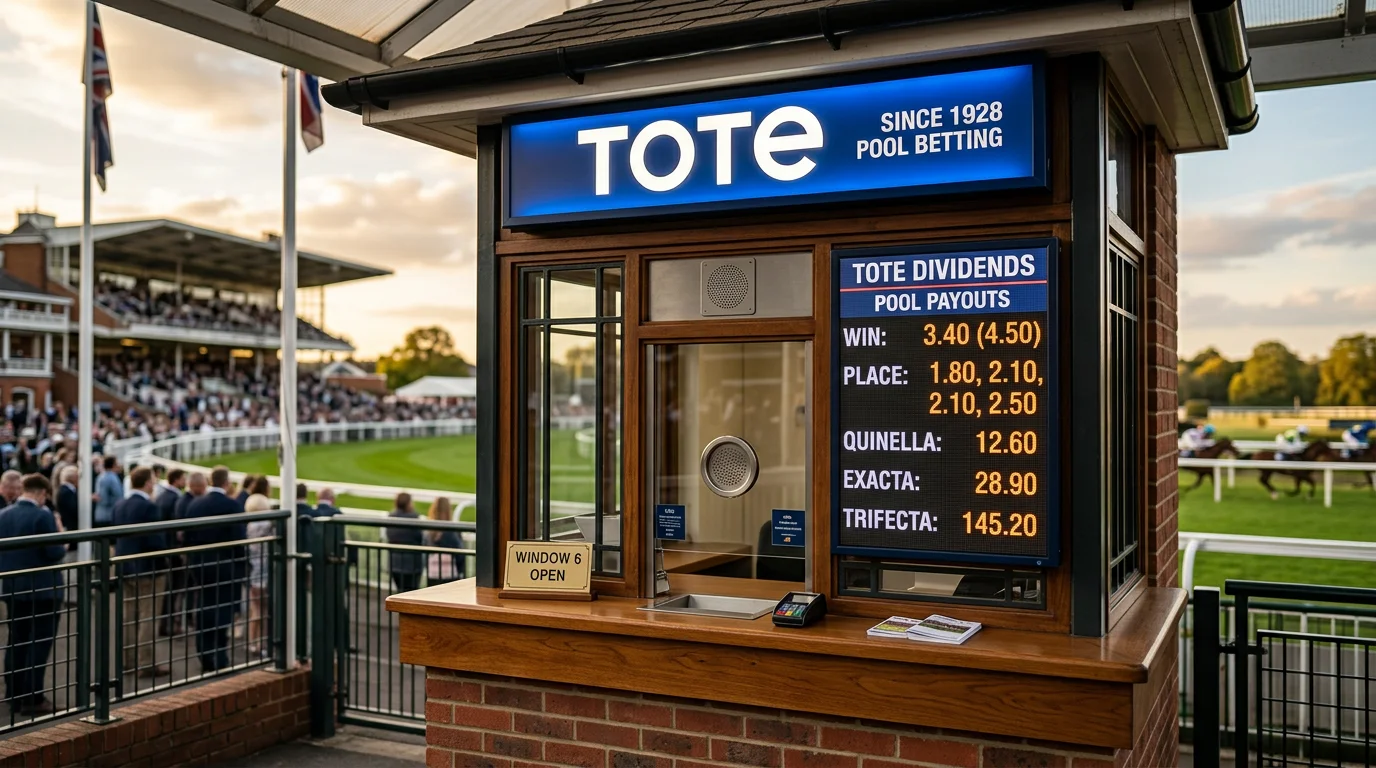
Most punters in Britain bet at fixed odds: they see a price, they take it, and that price determines their payout. But there is an entirely different betting system running alongside every race on every card — one where the price is not set until the race is over and the pool decides the price. That system is the Tote, and its dividends appear in the results of every British race whether you bet into the pool or not. Tote Dividends and Pool Betting Payouts Explained — More on this topic at horseracing results.
Pool betting has a long history in British racing. The Tote — formally known as the Horserace Totalisator Board, now operated under licence by a private company — pools all wagers on a given race, deducts a percentage for operating costs and contributions to racing, and distributes the remainder among winning bettors. The price you receive depends not on what a bookmaker offered, but on how much money went into the pool and how many people picked the winner. It is a fundamentally different mechanism from fixed odds, and it produces different payouts — sometimes better, sometimes worse, and always unpredictable until after the race.
This guide explains how the Tote mechanism works, describes each major Tote bet type, and shows exactly where and how dividends appear in the official results you find on any major racing platform.
How Pool Betting Works: The Tote Mechanism
The Tote operates on a parimutuel model — a French term meaning “mutual stake.” Every pound wagered into a Tote pool is combined with every other pound in that pool. Before the winning share is calculated, the operator deducts a take-out percentage, which funds the Tote’s operating costs, its contributions to prize money, and its profit margin. The remaining pool is then divided among all winning tickets in proportion to their stake.
Here is a simplified example. Suppose 1,000 punters each bet £1 to win on a six-horse race, creating a Tote Win pool of £1,000. The take-out is, say, 14%, leaving £860 to distribute. If 100 of those punters backed the winner, each receives a share of the £860 — roughly £8.60 for their £1 stake. If only 10 punters backed the winner, each receives about £86. The fewer people who backed the winner, the larger each winning dividend.
This is the fundamental difference between pool and fixed-odds betting. In fixed odds, the bookmaker sets a price and accepts the risk that it was wrong. In pool betting, there is no bookmaker price — the market of fellow punters determines your return. This means the Tote can produce dividends significantly higher or lower than the equivalent SP. A horse that attracts heavy Tote support will return a smaller dividend than its SP might suggest, because more of the pool is allocated to the winning side. Conversely, a horse ignored by Tote punters but backed in the fixed-odds market can return a generous Tote dividend — sometimes dramatically so.
The scale of the overall betting market gives this mechanism its context. The Gambling Commission recorded £766.7 million in gross gaming yield from remote horserace betting in the 2024-25 financial year. Tote pools represent a fraction of that total — fixed odds dominate the market — but for certain bet types, particularly exotic multiples, the Tote offers opportunities that fixed-odds markets cannot match.
Tote Win, Place, Exacta, Trifecta, Placepot and Jackpot
The Tote offers a range of pool bet types, from the straightforward to the fiendishly complex. Each has its own pool, its own take-out rate, and its own dividend published in the results.
Tote Win is the simplest: back a horse to win the race. The pool is divided among all winning tickets. This is the direct Tote equivalent of a fixed-odds win bet, and the dividend can be compared directly against the SP. When the Tote Win dividend exceeds the SP, you got better value from the pool; when it is less, the fixed odds would have been kinder.
Tote Place operates on the same principle but for placed horses — typically the first two in races of five to seven runners, the first three in races of eight or more, and the first four in handicaps of sixteen or more runners. Each placed horse generates its own dividend from the Place pool. Place dividends tend to be smaller than Win dividends, naturally, since more outcomes qualify.
Exacta requires you to pick the first and second in the correct order. It is a two-horse forecast bet into a Tote pool. Because the number of possible outcomes is much larger than a simple win bet, Exacta dividends can be substantial — particularly in big-field handicaps where the result is hard to predict. An Exacta in a competitive twenty-runner handicap can pay hundreds of pounds for a £1 stake.
Trifecta extends the challenge to the first three in the correct order. The mathematical difficulty of selecting three horses in sequence produces dividends that can run into thousands. Trifectas are popular on major race days — Grand National Trifectas, for instance, regularly produce five-figure returns for a small stake, driven by the unpredictable nature of the race and the large number of runners.
Placepot is one of the Tote’s most popular products. It requires you to pick a placed horse in each of the first six races at a given meeting. The pool accumulates across those six races, with the dividend reflecting how many successful tickets survive to the final leg. On big-field meetings, the Placepot can produce significant payouts even for modest stakes, and its structured, race-by-race format appeals to punters who enjoy the accumulating tension of a meeting-long bet. The off-course betting market — worth £3.33 billion in turnover as of March 2023 — includes a healthy share of Placepot activity on feature race days.
Jackpot and Scoop6 are the big-pool exotics. The Jackpot requires you to pick the winner of six specified races; the Scoop6, managed by the Tote, targets major Saturday races with a guaranteed minimum pool. These bets produce the largest Tote dividends — sometimes six figures — but are correspondingly difficult to land. Rollovers from meetings where no one picks all six correctly swell the pool further, creating the occasional lottery-sized payout that dominates racing headlines.
Where Tote Dividends Appear in Official Results
In official race results, Tote dividends are published below the finishing order, typically in a dedicated section labelled “Tote Returns” or “Tote Dividends.” The format shows the dividend per £1 stake for each bet type.
A results entry might read: “Tote Win: £4.80. Places: £1.90, £3.10, £1.50. Exacta: £42.30.” This tells you that a £1 Tote Win bet on the winner returned £4.80 (including the £1 stake), the three placed horses returned £1.90, £3.10, and £1.50 respectively per £1 Place stake, and the Exacta — first and second in correct order — paid £42.30 to a £1 stake.
Placepot and Jackpot dividends are published separately, usually at the end of the meeting rather than after each race, because these bets span multiple races. The Placepot dividend is declared after the sixth race; the Jackpot or Scoop6 dividend after the final qualifying leg. These figures appear on results pages and on the Tote’s own platforms.
One detail worth noting: Tote dividends are always expressed as returns to a £1 unit stake, inclusive of that stake. A dividend of £4.80 means your total return is £4.80, of which £1 was your original stake and £3.80 is profit. This convention is consistent across all Tote products and matches the way SP is expressed in fractional format — but new punters occasionally confuse the two, expecting to add the stake on top of the quoted dividend. See also UK Racecourse Directory.
The health of the Tote pool matters for the quality of dividends. HBLB chief executive Alan Delmonte noted a levy yield forecast of £103 million for 2025-26 — a figure closely tied to overall betting turnover, of which pool betting forms a part. Larger pools produce more stable, representative dividends; smaller pools can be volatile, with a single large stake from one punter distorting the payout for everyone else. On quiet midweek meetings, Tote pool sizes can be modest, and the dividends may not reflect true market value. On major festival days, the pools swell, and the dividends become a more reliable indicator of collective punter sentiment — a parallel currency to the SP, where the pool decides the price.
