
 Available in US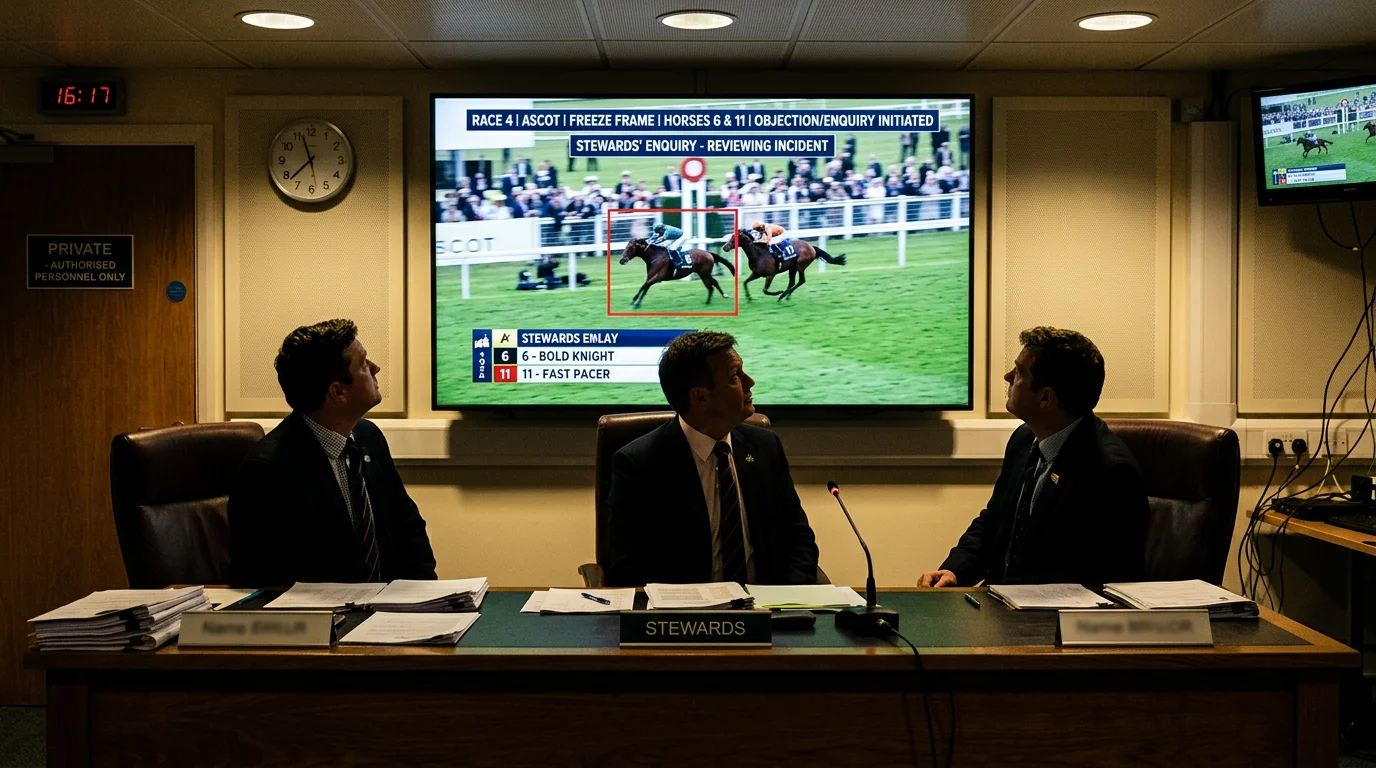
A horse crosses the line first. The crowd cheers. The SP is returned. And then the announcement comes over the public address: “Stewards’ enquiry.” In that moment, the result you thought was settled is thrown into doubt. The verdict that rewrites the result is one of the most dramatic interventions in British racing — a formal process that can promote a beaten horse to first, demote a winner to last, or leave the placings unchanged after an agonising review. Stewards’ Enquiry Explained — More on this topic at horseracing results.
Stewards’ enquiries are not common relative to the total number of races run, but they are common enough that every regular punter will encounter several each season. Understanding what triggers them, how the process works, and what the consequences are for finishing orders and betting payouts is essential knowledge — particularly if you have money riding on the outcome.
What Triggers a Stewards’ Enquiry or Objection
A stewards’ enquiry can be initiated in two ways: by the stewards themselves, acting on what they observed during the race, or by a jockey lodging a formal objection against another runner.
The stewards — a panel of officials appointed by the BHA to oversee every race meeting — watch the action from a vantage point equipped with multiple camera angles and real-time replay technology. If they observe interference, dangerous riding, or any incident that may have affected the finishing order, they will call an enquiry. This is the most common trigger: the stewards spot something and decide to investigate, without any jockey needing to complain.
A jockey objection occurs when a rider believes their horse was unfairly impeded by another during the race — bumped, squeezed, or denied a clear run — and that the interference cost them a better finishing position. The jockey signals the objection to the clerk of the scales immediately after dismounting, and the stewards are then obliged to investigate. Jockey objections are less frequent than steward-initiated enquiries, partly because jockeys are reluctant to object against colleagues with whom they ride daily, and partly because the threshold for a successful objection is high.
Other triggers include suspected non-trier enquiries (where the stewards believe a horse was not ridden on its merits), whip rule violations, and concerns about a horse’s running that deviate from its expected form. Across the 1,458 fixtures scheduled for 2026, stewards will conduct hundreds of enquiries — the vast majority resulting in no change to the result, but a meaningful minority producing amended placings that affect punters, owners, and the form book.
The stewards also have the power to enquire into incidents after the raceday has finished. If new evidence emerges — typically from patrol camera footage reviewed later, or from veterinary or laboratory reports — the BHA’s disciplinary panel can reopen the result and impose retrospective changes. These post-meeting enquiries are rarer but can have significant consequences, including disqualification for prohibited substance violations.
Step by Step: How an Enquiry Unfolds
When a stewards’ enquiry is announced, the result is suspended. No official placings are confirmed, and betting payouts are held until the enquiry concludes. The process follows a structured format designed to be fair to all parties.
First, the stewards review the available footage. Modern racecourses are equipped with multiple camera positions — head-on cameras, side-on cameras, patrol cameras following the field from overhead — and the stewards can watch the incident from every available angle, in slow motion and at normal speed. This technological infrastructure is part of the same operational framework that delivers 82.2% off-time punctuality across British racing — a system built on precision and accountability.
Next, the stewards interview the jockeys involved. Each rider gives their account of what happened: where their horse was positioned, what they saw, whether they were affected by another runner’s actions. The jockeys are questioned separately, and their accounts are compared against the camera evidence. The horse’s trainer may also be interviewed if the enquiry concerns the horse’s running or fitness.
The stewards then deliberate. Their decision is based on two key questions: did interference occur, and if so, did it affect the finishing order? Interference alone is not sufficient to change the result — it must be shown that the horse that suffered the interference would have finished in a better position but for the incident. This is a judgment call, and reasonable people can disagree on the outcome. The stewards make their best assessment based on the evidence available.
The announcement is made over the public address and published on the official results. If the result is amended, the new finishing order replaces the original. If the result stands — the most common outcome — the initial placings are confirmed. The entire process typically takes between five and twenty minutes, though complex cases involving multiple horses or serious interference can take longer.
How Amended Results Affect Finishing Orders and Payouts
When a stewards’ enquiry changes the finishing order, the consequences ripple through the betting market and the form book.
For win bets, the impact is straightforward. If Horse A crossed the line first but is demoted to second after an enquiry, and Horse B is promoted to first, then bets on Horse B are settled as winners. Bets on Horse A are settled on its amended position — second — which means win bets lose but each-way bets on Horse A may still pay out on the place part, depending on the terms.
For each-way and place bets, the amended order determines the payout. If a horse is promoted from fourth to third after an enquiry, each-way bets on that horse now collect the place dividend. Conversely, a horse demoted from third to fourth loses its place position, and each-way bets on it pay only the win part — which, if the horse did not win, means the bet loses entirely.
Forecast and tricast bets — which require you to predict the first two or first three in the correct order — are particularly sensitive to amended results. A stewards’ enquiry that swaps the first two horses invalidates every forecast that predicted the original order and validates those that predicted the amended order. The volatility this creates is one reason some punters avoid forecast bets in races where interference is a known risk, such as large-field handicaps on tight tracks.
For the form book, the amended result is what counts. Future form analysis uses the official finishing order as determined after any enquiry, not the order in which the horses crossed the line. This means a horse that was demoted from first to last carries “last” in its form figures, even though it physically crossed the line first. Reading form without checking for amended results is a trap that catches the unwary — and one that is entirely avoidable by using platforms that display the official result rather than the raw finishing order. See also Racecards Explained.
The stewards’ enquiry is, in essence, the sport’s quality-control mechanism for results. It ensures that the finishing order reflects a fair race, not one distorted by interference or rule violations. For punters, it adds an element of uncertainty to the period immediately after a race — but for the integrity of the form book, it is indispensable.
