
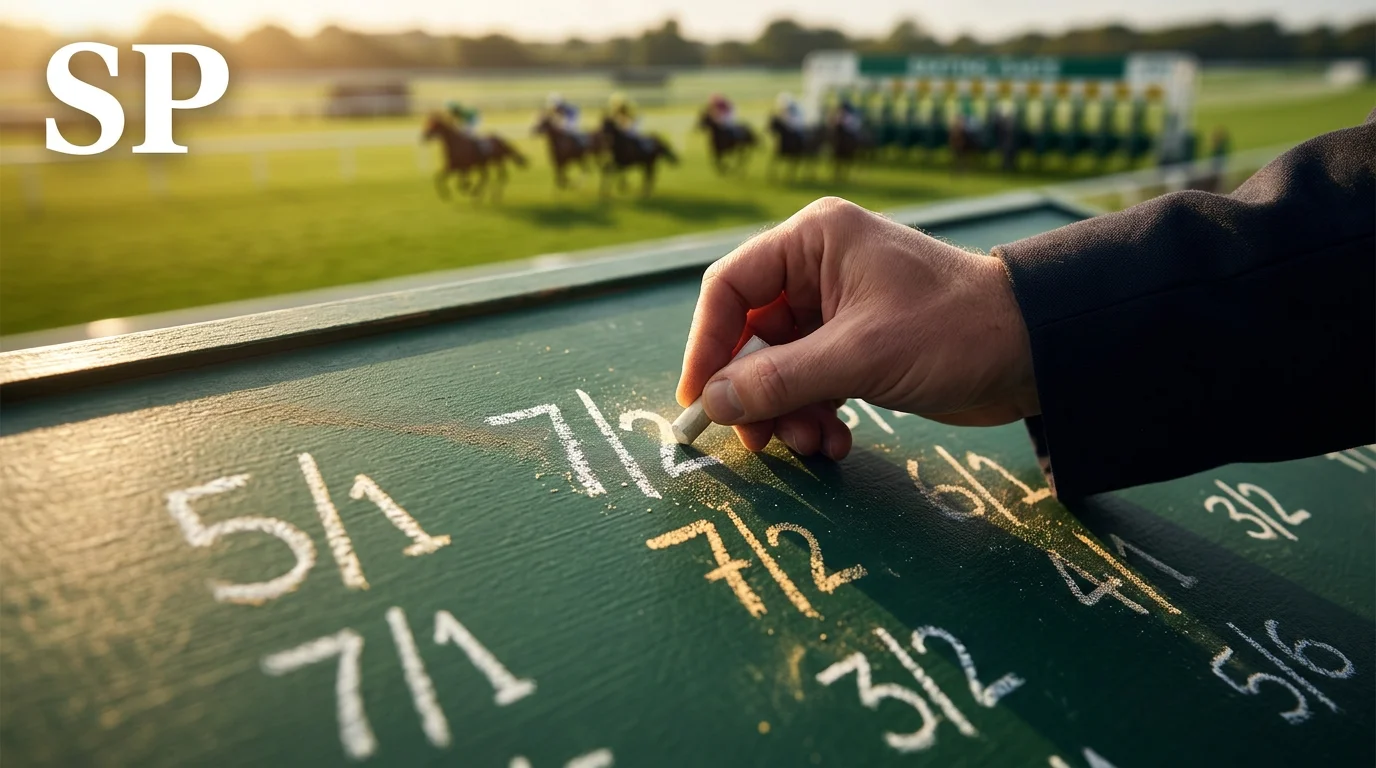
Every set of horse racing results in Britain carries a column that confuses newcomers and occasionally frustrates veterans: SP. Two letters, no explanation, sitting quietly beside a finishing position as though everyone should know what they mean. And in a sport that generated £766.7 million in gross gaming yield from remote betting on horseracing alone in the 2024-25 financial year, understanding those two letters is not a trivial exercise.
SP stands for Starting Price — the price that settles your bet if you have not taken a fixed price beforehand. It is the last available odds on a horse at the moment the race begins, determined by an independent body — the Starting Price Regulatory Commission (SPRC) — using a sample of major off-course bookmaker prices. Until 2022 the SP was based on the on-course betting ring; since May 2022 it has been compiled primarily from off-course operators, reflecting the reality that on-course betting accounts for barely 1–2% of total horseracing turnover. That distinction matters more than most punters realise, and SP has shaped the economics of British racing for well over a century.
This guide breaks down exactly how SP is formed, how it compares to fixed odds and Best Odds Guaranteed offers, and where you will find it sitting in every official result card. Whether you are a casual once-a-year punter checking Grand National results or a regular student of the form book, SP is the price you cannot avoid.
How the Starting Price Is Set on Course
The Starting Price is not plucked from thin air. It is compiled by the SPRC using data gathered from a sample of licensed off-course bookmakers at the moment the race begins. The SPRC’s methodology orders each bookmaker’s price from longest to shortest, splits the list in half and takes the shortest odds in the longer-priced half — effectively a median-based calculation designed to filter out outlier prices. The SP, or a longer price, will have been offered by at least half the bookmakers in the sample.
This process has changed significantly over the decades. Before 2022, the SP was the domain of on-course reporters who monitored the physical betting ring, recording the odds offered by rails bookmakers just as the starter called the field to order. When Covid-19 forced racing behind closed doors in 2020, the SPRC switched to off-course prices as a temporary measure. A subsequent review found that on-course betting represented just 1.4% of total horseracing turnover, and in May 2022 the SPRC made the off-course basis permanent. Today the on-course market still contributes a component, but the overwhelming weight sits with the major online and shop-based operators.
Why does this matter? Because the sample bookmakers are adjusting prices in real time based on money coming in across the market. If a horse is heavily backed in the final minutes before a race, its SP will shorten — sometimes dramatically. Conversely, a horse that drifts, attracting little late support, will return a bigger SP than its morning price might have suggested. This dynamic is why SP can differ markedly from the odds you saw advertised at 10 a.m. on a bookmaker’s website.
There is a common misconception that SP is simply the average of all bookmaker odds. It is not. The SPRC’s median-based methodology means outlier prices — a single firm offering 20/1 when every other board shows 14/1 — do not skew the returned SP. The system is designed to produce a fair reflection of genuine market sentiment, and it is regulated precisely because it settles millions of pounds in wagers every racing day.
For punters betting online without taking a fixed price, the SP is the default settlement mechanism. You back a horse at SP, the race goes off, and whatever the on-course market declared becomes your odds. Simple in theory, occasionally frustrating in practice — particularly when a horse you fancied at 8/1 in the morning returns at 4/1 SP after a wave of late money.
SP vs Fixed Odds and Best Odds Guaranteed
The distinction between SP and fixed odds is one of the first things any serious punter needs to grasp, because it fundamentally changes how you are paid out — and how much risk the bookmaker carries.
When you take a fixed price, you lock in the odds at the moment you place your bet. If you back a horse at 10/1 on Monday morning and by Saturday’s race it has been backed down to 5/1, your bet still pays at 10/1. The bookmaker has accepted that liability. The flip side is equally true: if the horse drifts from 10/1 to 16/1, you are stuck with your original price. Fixed odds are a contract between you and the bookmaker, frozen in time.
SP, by contrast, is a floating settlement. You are effectively saying: whatever the market decides at the off, that is my price. This can work in your favour — a horse that drifts late will give you better value at SP than if you had locked in earlier. But it can also cost you, badly, when late money floods in on a well-fancied runner and the price collapses.
Then there is Best Odds Guaranteed, or BOG — the promotional mechanism that tries to give punters the best of both worlds. Under BOG, if you take a fixed price and the SP is higher, most major bookmakers will pay you at the SP instead. If the SP is lower, you keep your fixed price. It sounds like an obvious win for the punter, and in many individual cases it is. But bookmakers are not running a charity: BOG is funded by the margin built into their overall book, and the off-course betting market — which saw turnover of £3.33 billion as of March 2023, down 42% from 2009 — has been adjusting to the cost of these promotions for years.
For the casual punter, BOG removes much of the anxiety around timing. You take the best price you can find early, safe in the knowledge that if the market moves in your favour, you will be upgraded. For sharper punters who trade on market movements, the dynamic is different: they might deliberately bet at SP on horses they expect to drift, banking on the on-course market being less efficient than the exchange or online early-morning markets.
The practical upshot is straightforward. If you are placing a bet on a horse you fancy and a BOG offer is available, take the fixed price. If no BOG offer exists and you believe the horse may drift, SP is a reasonable default. And if you are checking results after the fact, the SP column tells you exactly what the market thought of each runner at the moment it mattered most.
Where SP Appears on a Result Card
Open any official result from a British racecourse and the SP column sits alongside the finishing order, typically expressed as a fractional price. A result might read: 1st — Cityscape, SP 9/4. That means anyone who backed Cityscape at SP collected at odds of 9/4. On most results platforms — Racing Post, Sporting Life, the BHA’s own records — the SP is displayed in fractional format, the traditional British style. Some sites offer a toggle to decimal, but the underlying data is the same.
In results tables, SP is usually positioned after the horse name and jockey, and before or alongside the finishing distance and in-running commentary. For non-runners, no SP is returned. For horses that were withdrawn at the start — under starter’s orders but failing to race — specific rules govern whether a Rule 4 deduction applies to remaining runners. The SP column in such cases will sometimes carry an annotation or footnote directing you to the relevant deduction.
Where things get slightly more complex is in the distinction between the returned SP and the Industry Starting Price, or ISP. The ISP is a more recent development, introduced to provide a standardised, auditable price for settlement by online operators. In practice, the ISP and the traditional SP are usually identical or very close, but the ISP framework was designed to add a layer of governance and transparency that the older system lacked. When you see SP quoted on a results page, it is generally the ISP that has been used for settlement by online bookmakers.
For punters reviewing results after the event, the SP column is invaluable beyond mere payout calculations. It tells you what the market collectively believed about each horse’s chance. A horse that won at 33/1 SP was genuinely unfancied by the weight of money — a shock result by any definition. A winner at 4/6 SP was expected to oblige and delivered. Reading SP across a sequence of results for the same horse gives you a rough trajectory of market confidence: a horse returning SPs of 20/1, 12/1, 8/1 across three consecutive runs is clearly rising in the estimation of those willing to back their judgement with cash.
Two letters, then, but a surprising amount of information packed behind them. SP is not just the price that settles your bet — it is a compressed summary of what the market knew, or thought it knew, at the moment the stalls opened. Learn to read it properly, and results stop being a list of finishing positions. They become a story.