
 Available in US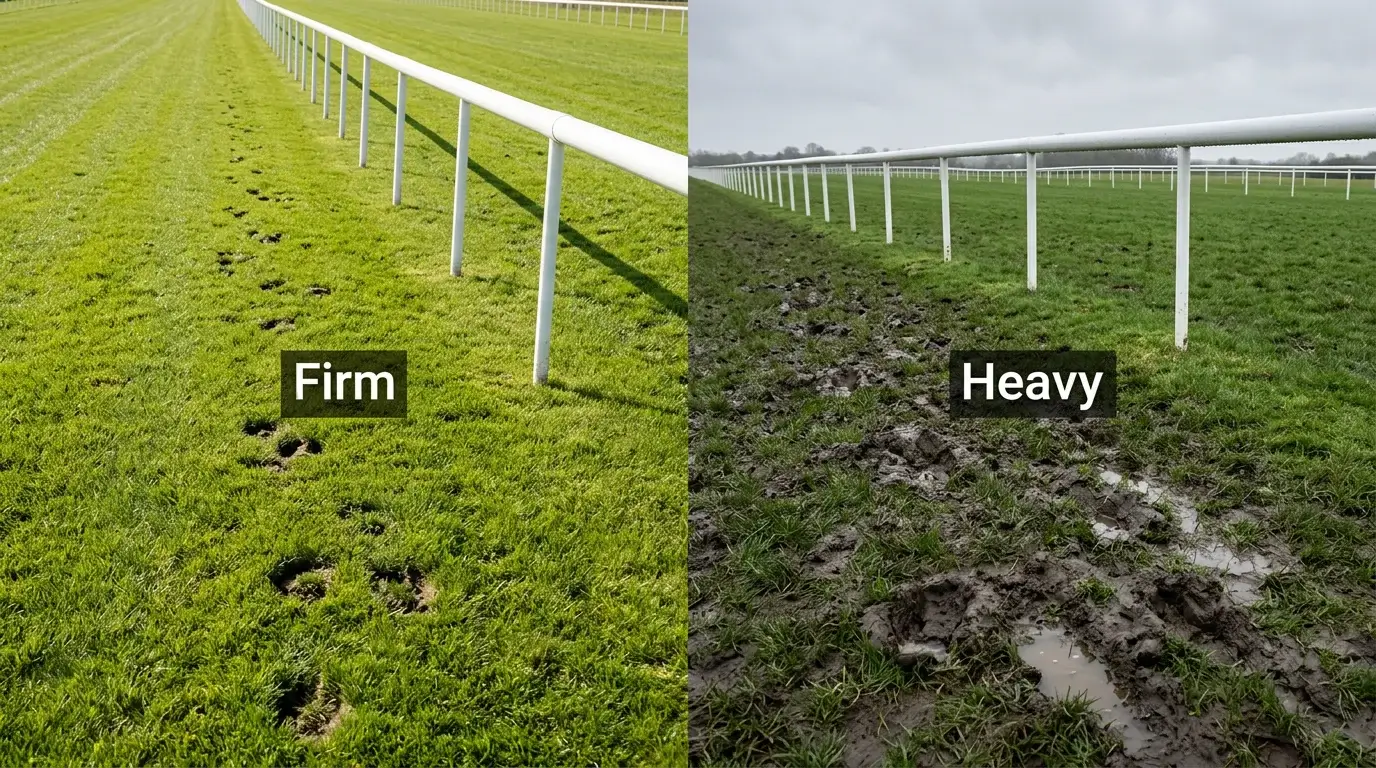
Before a single horse leaves the stalls, one piece of information has already shaped the result: the going. It is the ground beneath every result — the variable that determines which horses are advantaged, which are compromised, and which might as well have stayed at home. Yet for many casual racegoers, the going description at the top of a result card is something they skim past without a second thought. Horse Racing Going Explained — More on this topic at horseracing results.
That is a mistake. In a country where the weather can produce firm, sun-baked turf in June and bottomless, energy-sapping mud in January — sometimes on the same racecourse a few months apart — the going is the single most important environmental factor in British racing. Some horses move like machines on fast ground and flounder the moment the rain arrives. Others are transformed by soft conditions, grinding through heavy turf with a stamina that quicker-ground horses cannot match.
This guide covers the full UK going scale from Hard to Heavy, explains how the GoingStick and modern technology have changed the way courses report conditions, and shows how ground conditions alter finishing times, distances, and the overall shape of a result.
The UK Going Scale: Every Description from Hard to Heavy
The UK going scale is a standardised set of descriptions that runs from the fastest surface to the slowest. Each description corresponds to a range of ground conditions, and the BHA requires every racecourse to declare the going before racing — and to update it if conditions change.
Hard is the extreme fast end: bone-dry ground with no give whatsoever. Racing rarely takes place on genuinely hard ground because the jarring effect on horses’ legs is considered a welfare risk. Most courses will water the track or postpone fixtures rather than race on hard ground. It is the rarest official description in British racing.
Firm is fast, dry ground with minimal cushion underfoot. Flat racing can take place on firm ground without major concerns, and many top-class Flat horses produce their best performances on it. In National Hunt racing, firm ground is avoided where possible because the landing impact after jumping on unyielding turf increases the risk of injury.
Good to Firm is the sweet spot for a large proportion of Flat racing. The ground is drying but retains enough moisture to provide some cushion. Many trainers consider Good to Firm the ideal surface for fast, clean racing, and the quickest times at most courses are recorded on this going. Around 60% of Britain’s approximately 10,000 annual races are run on the Flat, where Good to Firm is a common summer description, while the remaining 40% are Jump races that more often encounter softer conditions — a split documented by Statista.
Good is the neutral point on the scale — neither fast nor slow, with an even amount of moisture and give. Good ground suits the widest range of horses and is generally considered the fairest testing surface. Results on good ground are often regarded as the most reliable form because they minimise the bias introduced by extreme conditions.
Good to Soft marks the transition towards winter-like conditions. There is noticeable give in the ground, and horses that prefer faster surfaces may start to struggle. This is common in spring and autumn — the shoulder seasons where the ground sits between the summer firm and the winter soft.
Soft is demanding ground. It takes more energy to gallop through, which means stamina becomes a more important factor than raw speed. Finishing times slow down markedly, and winning distances often increase because the horses at the back of the field are disproportionately affected by fatigue. National Hunt racing frequently takes place on soft ground, and many jump horses are specifically bred and trained for it.
Heavy is the extreme slow end: saturated, waterlogged turf that tests stamina to the limit. Racing on heavy ground produces dramatically different results from the same race on good ground. Horses that cannot act in heavy conditions will stop as though they have hit a wall. Specialists in these conditions — often powerful, scopey types with endless stamina reserves — can win by huge margins against opponents who would beat them comfortably on faster surfaces.
GoingStick Readings and How Courses Report Conditions
For decades, the going was assessed by the clerk of the course walking the track and making a subjective judgement. That system had an obvious flaw: one person’s “Good to Soft” was another’s “Soft.” Trainers and punters could never be entirely sure that the declared going matched what their horse would actually encounter.
The GoingStick changed that. Introduced to British racing in 2007 and mandatory at all turf meetings since 2009, it is a penetrometer — a handheld device pushed into the turf that measures both the force needed to penetrate the ground and the shear force as the stick is moved laterally. These two readings are combined into a single numerical value on a scale of roughly 0 to 15, where higher numbers indicate firmer ground and lower numbers indicate softer ground. Critically, the GoingStick reading does not map directly to a fixed going description — the same reading can correspond to different conditions at different tracks, because soil type, drainage and local factors all vary. Clerks of the course still provide a verbal description alongside the number.
The advantage of the GoingStick is objectivity. It provides a number rather than a word, and numbers are harder to argue with. Courses now publish GoingStick readings alongside the declared going, typically in the morning before racing and again after an inspection if conditions have changed. With 1,458 fixtures scheduled across Britain in 2026 — a calendar that spans every month and every type of weather the country can produce — the GoingStick has become an essential tool for standardising what was once a wholly subjective assessment.
That said, the GoingStick is not infallible. It measures conditions at specific points on the track, but ground can vary significantly from the stands rail to the far rail, or from the straight course to the round course. Courses take multiple readings and report an average, but localised patches of softer or firmer ground — caused by drainage, shade, or heavy foot traffic — can still catch out horses and punters who rely solely on the headline figure.
Courses also employ their own groundstaff to manage conditions. Watering systems can artificially soften firm ground in summer, while drainage and frost covers protect the surface in winter. The declared going, then, is not purely a reflection of the weather — it is a managed output, shaped by both nature and human intervention.
How Going Alters Finishing Times, Distances and Results
The going affects everything: times, distances, tactics, and which horse crosses the line first. Understanding how it does so is not optional for anyone who wants to read results with any depth.
Start with times. A mile on Good to Firm ground at Newmarket might produce a winning time of 1 minute 36 seconds. The same race, same course, on Heavy ground could take 1 minute 48 seconds or more. That twelve-second gap is enormous — it represents a fundamentally different race, run at a different pace, testing different qualities. Comparing times across different going conditions without adjustment is meaningless, which is why speed-rating systems like Topspeed and Timeform always factor in the going before assigning a number to a performance.
Finishing distances shift too. On fast ground, horses tend to finish closer together because the pace is high and the strongest finishers have less time to reel in the leaders. On soft or heavy ground, gaps widen as stamina gives out at different rates. A five-length winning margin on heavy ground might equate to a two-length margin on good ground in terms of the actual ability difference between the horses. Form analysts who fail to account for this will overrate soft-ground winners and underrate beaten horses who simply could not handle the conditions.
Tactically, the going changes how jockeys ride. On fast ground, front-runners have a natural advantage because the pace is manageable and they can control the race from the front without burning excessive energy. On soft ground, making the running becomes far more taxing — the horse at the front is doing all the work through demanding conditions while those tucked in behind save energy. This is why you see more results on soft ground where closers and hold-up horses get the better of prominent racers, and why the going should inform your assessment of running styles in future races. See also Official Ratings in Horse Racing.
Then there is the going preference of individual horses. Some horses simply cannot act on certain ground. A horse with a record of 1111 on Good to Firm and 0600 on Soft is telling you something unmistakable. Results carry the going description for every race, and building a horse’s going-preference profile from its result history is one of the most reliable analytical tools available. It does not require complex mathematics or expensive data — just the patience to check what ground the horse ran on each time it appeared and to note whether the performance was better or worse than expected.
The going is declared. It is published. It is there in every result, attached to every performance. It costs nothing to read and nothing to factor into your analysis. Ignoring it is the one mistake that no amount of form study can overcome.
