
 Available in US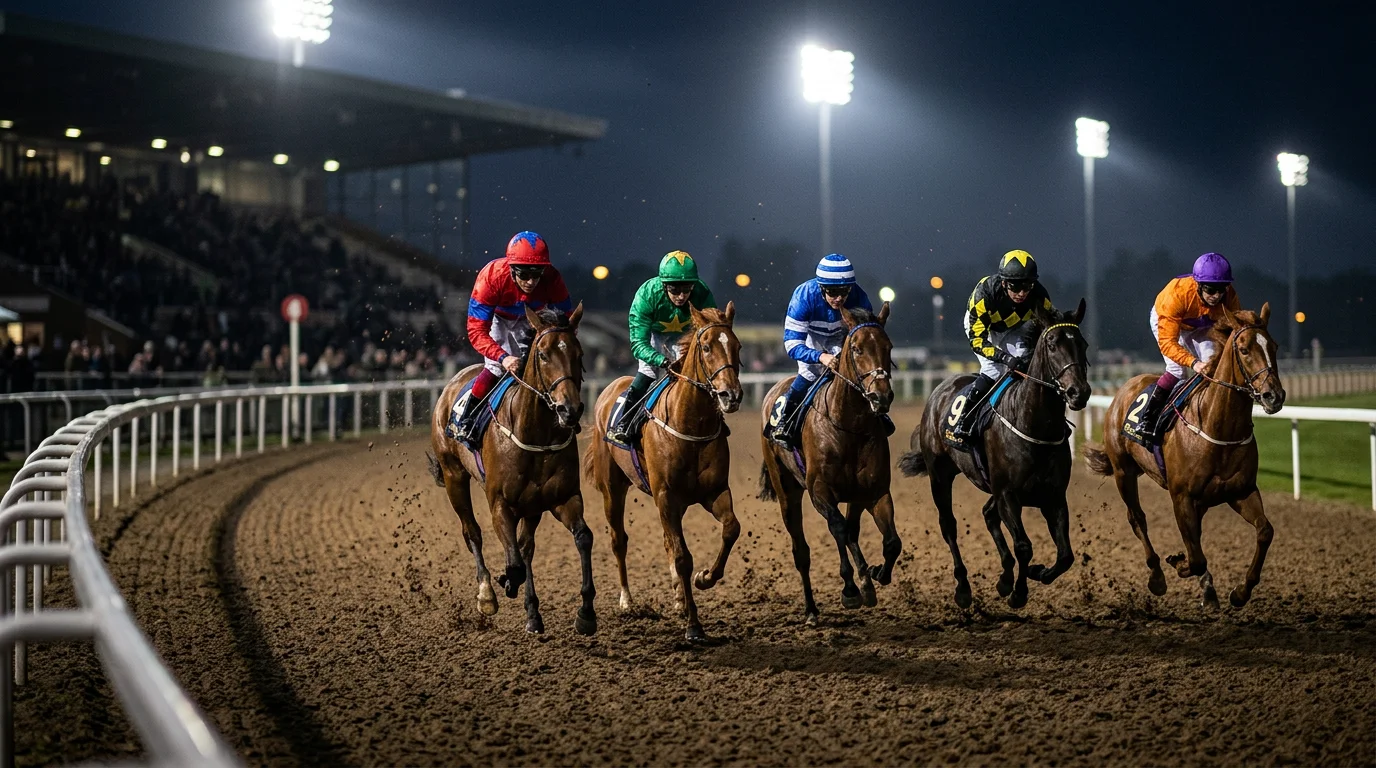
When the frost comes down and the turf tracks close their gates, British racing does not stop. It moves indoors — or rather, onto synthetic surfaces at a network of all-weather venues that keep the sport running twelve months a year. Racing that never stops for the weather is not a slogan; it is a practical reality that ensures continuity for trainers, jockeys, owners, and punters through the darkest months of the calendar. All-Weather Racing Results in the UK Explained — More on this topic at horseracing results.
All-weather racing has grown from a winter stopgap into a significant component of the British fixture list. The surfaces are different from turf, the form is different from turf, and the results require a different analytical lens. Horses that excel on Polytrack may struggle on Tapeta. Horses that dominate on Fibresand may flounder on turf. Understanding these differences is not optional for anyone who bets on or follows British racing year-round.
This guide compares the three synthetic surfaces used in Britain, profiles the seven all-weather venues, and addresses the question that every form student asks: does turf form translate?
Polytrack, Tapeta and Fibresand: How They Ride
The three artificial surfaces used on British racecourses are not interchangeable, and treating them as a single category labelled “all-weather” is a mistake that costs punters money.
Polytrack is the most widely used surface, installed at Lingfield, Kempton, and Chelmsford. It consists of a blend of polypropylene fibres, recycled rubber, and silica sand, coated with a wax binder. The result is a surface that is generally considered closest to good turf in its riding characteristics — it offers cushion without excessive drag, drains quickly, and produces consistent going from one meeting to the next. Horses with turf form on good ground tend to transfer to Polytrack more reliably than to the other surfaces. Times on Polytrack are typically comparable to those on good-to-firm turf.
Tapeta is the surface at Wolverhampton and Newcastle. Developed by Michael Dickinson, a former champion trainer, it is a mix of silica sand, wax, and synthetic fibres designed to minimise kickback and provide a uniform riding surface. Tapeta tends to ride slightly differently from Polytrack — opinions vary among trainers, but the consensus is that it is a touch slower and places a slightly greater emphasis on stamina. Newcastle’s Tapeta track, being a large left-handed galloping course, produces form that is considered among the strongest in all-weather racing, while Wolverhampton’s tighter left-handed circuit creates a different test entirely.
Fibresand is used only at Southwell and is the outlier. It is a deeper, sandier surface that rides heavier than either Polytrack or Tapeta, producing slower times and demanding more stamina from the runners. Fibresand specialists — horses that love the surface and handle its heavy feel — are a distinct category within all-weather form. A horse that wins at Southwell on Fibresand may not reproduce that form on Polytrack at Lingfield, and vice versa. The surface has its critics, but it produces competitive racing and has a loyal following among punters who specialise in its unique form patterns.
Across the 1,458 fixtures scheduled for 2026, all-weather meetings account for a significant share of the winter programme, ensuring that racing continues when turf courses are frozen, waterlogged, or resting ahead of the spring.
All-Weather Venues: Seven Tracks Profiled
Each of the seven all-weather tracks in Britain has its own character, and results at one venue do not always translate to another.
Lingfield is a left-handed, sharp, undulating track on Polytrack. Its tight bends and short straight favour horses that can travel handily and quicken off a turn. The track also has a turf course, making it a dual-purpose venue, but its all-weather programme is the primary draw through the winter. Sprint results at Lingfield are often influenced by the draw and the ability to hold a prominent position around the bends.
Kempton operates on a right-handed, triangular Polytrack circuit that is flat and relatively fair. The long straights give horses room to make their challenges, and the track produces reliable form that transfers well to other Polytrack venues. Kempton’s all-weather programme includes several valuable evening meetings and feature races.
Chelmsford is the newest all-weather venue, with a left-handed Polytrack circuit. It has modern facilities and strong floodlighting, hosting regular evening fixtures. The track is generally considered fair, with a long straight that allows horses to come from off the pace.
Wolverhampton is a tight, left-handed Tapeta track with a short straight, meaning the draw and early positioning matter. Front-runners and horses drawn close to the inside rail have a statistical advantage, particularly in sprint races. Wolverhampton hosts a high volume of winter fixtures and is a workhorse of the all-weather calendar.
Newcastle is the most spacious of the all-weather venues — a large, left-handed Tapeta oval with long straights. Its galloping nature produces form widely regarded as the strongest in all-weather racing, and the track stages the All-Weather Championships Finals Day, the showcase event of the synthetic season. The BHA’s restructuring of Premier Racedays — reduced from 162 to 52 in 2026 — reflects a broader quality-over-quantity philosophy, and Newcastle’s Championships card is a direct beneficiary of that approach.
Southwell is the sole Fibresand venue, a left-handed, sharp track that produces a unique form profile. Racing here requires stamina and the ability to handle the deep surface, and form from Southwell should be treated with caution when applied to any other venue.
Dundalk in Ireland is sometimes referenced in UK form analysis because Irish-trained horses that have run there occasionally appear at British all-weather meetings. Its Polytrack surface provides a useful cross-reference for punters tracking horses that switch between British and Irish all-weather racing.
Does Turf Form Translate to All-Weather?
The short answer is: sometimes. The longer answer is that it depends entirely on which surface and which type of turf form you are comparing.
Horses with form on good-to-firm or good turf tend to transfer most successfully to Polytrack, which rides closest to those conditions. The transition to Tapeta is slightly less predictable, and the transition to Fibresand at Southwell is essentially a new test — turf form provides only a rough guide.
Going in the other direction — from all-weather to turf — is often more informative than people assume. A horse that has been winning on Polytrack through the winter and then runs on good turf in April may well reproduce that form, particularly if its turf record from previous seasons was already respectable. The all-weather season serves as a fitness platform for many trainers who use it to get horses race-fit before the turf campaigns begin. See also Horse Racing Fixture List 2026.
Where turf form becomes unreliable is with horses that have only ever raced on turf that was soft or heavy. These conditions bear little resemblance to any all-weather surface, and a horse whose form is built entirely on deep ground may struggle on the firmer, more consistent feel of Polytrack or Tapeta.
BHA chief executive Brant Dunshea has described British racing as having a vast, untapped market with significant growth potential. All-weather racing is one of the tools for capturing that audience — it offers regular, accessible fixtures with consistent conditions and competitive fields, and for the new or casual racegoer it provides an entry point that is less weather-dependent and less seasonally constrained than the turf programme. For the form analyst, it provides a year-round dataset that, read correctly, complements and enriches the turf form book.
