
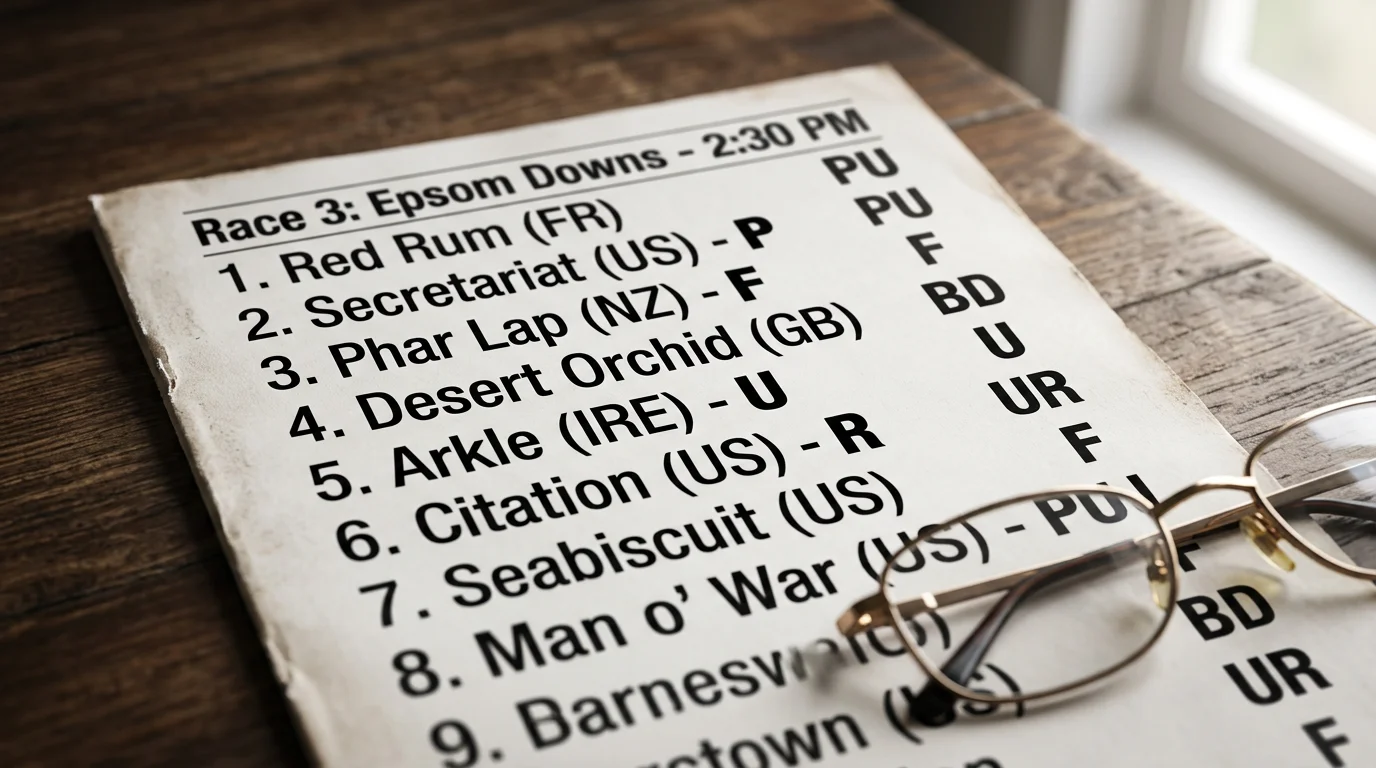
British horse racing results are dense with information, and a good portion of it arrives in the form of letters that look like a cipher to the uninitiated. P, F, U, R, BD — these are not random keyboard mashes. Each one describes something specific that happened to a horse during a race, and collectively they paint a far more detailed picture than the finishing order alone.
The abbreviation system exists because results need to communicate a lot in very little space. With 21,728 horses in training across Britain in 2025 and thousands of races run each year, the shorthand has evolved into something approaching its own language. Once you crack it, reading results becomes less like decoding and more like reading a newspaper — the letters disappear and the meaning comes through.
This guide covers every letter you will find in a standard UK racing result: the non-completion codes that tell you a horse did not finish, the performance markers that rate how well it ran, and the headgear codes that reveal what equipment a trainer has fitted to try and extract a better performance. Every letter explained, no jargon left behind.
Non-Completion Codes: P, F, U, R, BD, CO, SU
These are the codes you see instead of a finishing position when a horse does not complete the race. They are particularly common in National Hunt racing, where obstacles create more opportunities for things to go wrong. A peer-reviewed study published in the Equine Veterinary Journal found fatality rates of 5.9 per 1,000 starts in steeplechases and 4.5 per 1,000 in hurdles across the period 2010 to 2023 — numbers that underscore why these codes appear far more often in jump results than on the Flat.
P — Pulled Up. The jockey has deliberately stopped riding and pulled the horse out of the race before the finish. This is the most common non-completion code, and the reasons vary enormously. A horse might be pulled up because it is struggling with the pace, clearly beaten and with no chance of placing. It might be pulled up because the jockey feels something wrong — a suspected injury, laboured breathing, or a loss of action. In National Hunt racing, pulling up before an obstacle is often a welfare decision: a tired horse is a dangerous horse over fences. The stewards will usually ask the jockey for an explanation after any pull-up, and the veterinary officer will examine the horse.
F — Fell. The horse hit the ground during the race, almost always at an obstacle. A fall is distinct from being brought down (see BD below) because the horse’s own mistake — misjudging a fence, pecking on landing, hitting the top of a hurdle — caused it to go down. Falls are a standard part of jump racing, and while most horses and jockeys walk away, the code carries inherent seriousness. In Flat racing, falls are extremely rare and usually involve a horse clipping heels or stumbling.
U — Unseated Rider. The horse continued running but the jockey came off. This typically happens at an obstacle when a horse makes a mistake severe enough to dislodge the rider but not bad enough to bring the horse down entirely. A horse that unseats its rider will often continue galloping around the course loose, which is why you sometimes see riderless horses completing the race ahead of the remaining field — a peculiar and entirely unofficial result.
R — Refused. The horse refused to participate in the race or refused to jump an obstacle. At the start, a refusal means the horse would not leave the stalls or line. During a jump race, it means the horse planted its feet and declined the fence. A horse that runs out — veering around an obstacle rather than jumping it — is also typically coded R, though some results distinguish this with RO.
BD — Brought Down. The horse fell or was knocked over by another horse’s fall. This is the most frustrating code for punters because the horse did nothing wrong. A faller in front takes out your selection, and there is nothing anyone could have done about it. BD carries no negative implication about the horse’s ability or fitness — it is pure misfortune.
CO — Carried Out. The horse was forced off the course by another runner, typically at an obstacle. The distinction between CO and BD is that a carried-out horse does not necessarily fall — it may simply be pushed too wide to continue safely.
SU — Slipped Up. The horse fell on the flat, away from any obstacle. This is rare and usually indicates wet ground or a misstep. It is distinct from F because no jump was involved.
Performance and Status Markers: OR, TS, RPR, BF
Beyond the non-completion codes, results carry a separate set of markers that assess how a horse performed or describe its official standing. These appear most commonly on detailed results platforms like Racing Post and Timeform rather than on bare finishing-order tables.
OR — Official Rating. The number assigned by the BHA handicapper that determines how much weight a horse carries in handicap races. A horse rated OR 90 is considered a better performer than one rated OR 70, and will carry more weight as a result. The OR appears in results because it can change after every run — a horse that wins impressively may see its rating rise by several pounds, making its next handicap assignment tougher. Tracking OR movements across results is one of the core tools of form analysis.
TS — Topspeed Rating. A speed figure calculated by Racing Post that attempts to quantify how fast a horse ran in a given race, adjusted for track conditions and distance. TS figures allow comparison across different courses and days — a TS of 85 at Newmarket can be meaningfully compared to a TS of 85 at York, in theory at least. The higher the number, the faster the performance relative to the standard.
RPR — Racing Post Rating. A performance rating that blends speed and form analysis, produced by Racing Post’s handicappers. Unlike the official OR, which is a regulatory tool for weight allocation, RPR is an editorial assessment of ability. A horse with an RPR significantly higher than its OR is, by Racing Post’s estimation, ahead of the handicapper — and potentially well treated in its next race.
BF — Beaten Favourite. This marker flags a horse that was the shortest-priced runner in the race (the market favourite) but failed to win. BF is a punter’s shorthand for disappointment, but it is also an analytical marker: habitual beaten favourites are horses the market overrates, while a single BF in an otherwise consistent record may indicate a one-off poor performance worth forgiving.
Headgear and Equipment Codes in Result Listings
Trainers have a toolbox of headgear and equipment they can fit to a horse, and any change is recorded in the result alongside the horse’s name. These codes matter because a first-time application of headgear often signals a trainer trying something new — and that shift in approach can produce a dramatic change in performance.
b — Blinkers. Cups attached to the bridle that restrict a horse’s peripheral vision, forcing it to focus on what is ahead. Blinkers are the most common headgear and are used to stop horses from being distracted by other runners, the crowd, or the surroundings. A horse wearing blinkers for the first time is often worth noting — it suggests the trainer believes the horse has more ability than it has been showing and needs help concentrating.
v — Visor. Similar to blinkers but with a narrow slit rather than full cups, giving the horse some peripheral vision while still narrowing its focus. Visors are considered a slightly gentler intervention than full blinkers.
h — Hood. A fabric hood that covers the horse’s ears, used primarily to keep the horse calm in the pre-race environment — the parade ring, the walk to the start, the noise of the crowd. Some horses race in hoods; others have them removed at the start.
e/p — Eye Shield / Eye Cover. A less restrictive form of headgear that shades the horse’s eyes without the full tunnel vision of blinkers. Increasingly popular and sometimes used in combination with a hood.
t — Tongue Tie. A strap or elastic band that keeps the horse’s tongue in place during the race. This is not headgear in the traditional sense but is recorded the same way because it is a notable equipment change. Tongue ties prevent a horse from getting its tongue over the bit — a habit that can obstruct the airway and severely hamper performance. First-time tongue tie is one of the strongest positive equipment signals in racing, frequently associated with improved runs.
c — Cheekpieces. Strips of sheepskin attached to the cheekpieces of the bridle, restricting rear vision without blocking it entirely. Cheekpieces are milder than blinkers and are sometimes used as a stepping stone before applying full blinkers.
In results listings, these codes typically appear as lowercase letters in brackets after the horse’s name — for example, “Frankel (b)” or “Sprinter Sacre (t1)” where the “1” suffix indicates first-time application. That first-time marker is the one that sharp punters watch most closely. A horse trying blinkers or a tongue tie for the first time is, in effect, running a different race to its previous outings, and the results often reflect it.