
 Available in US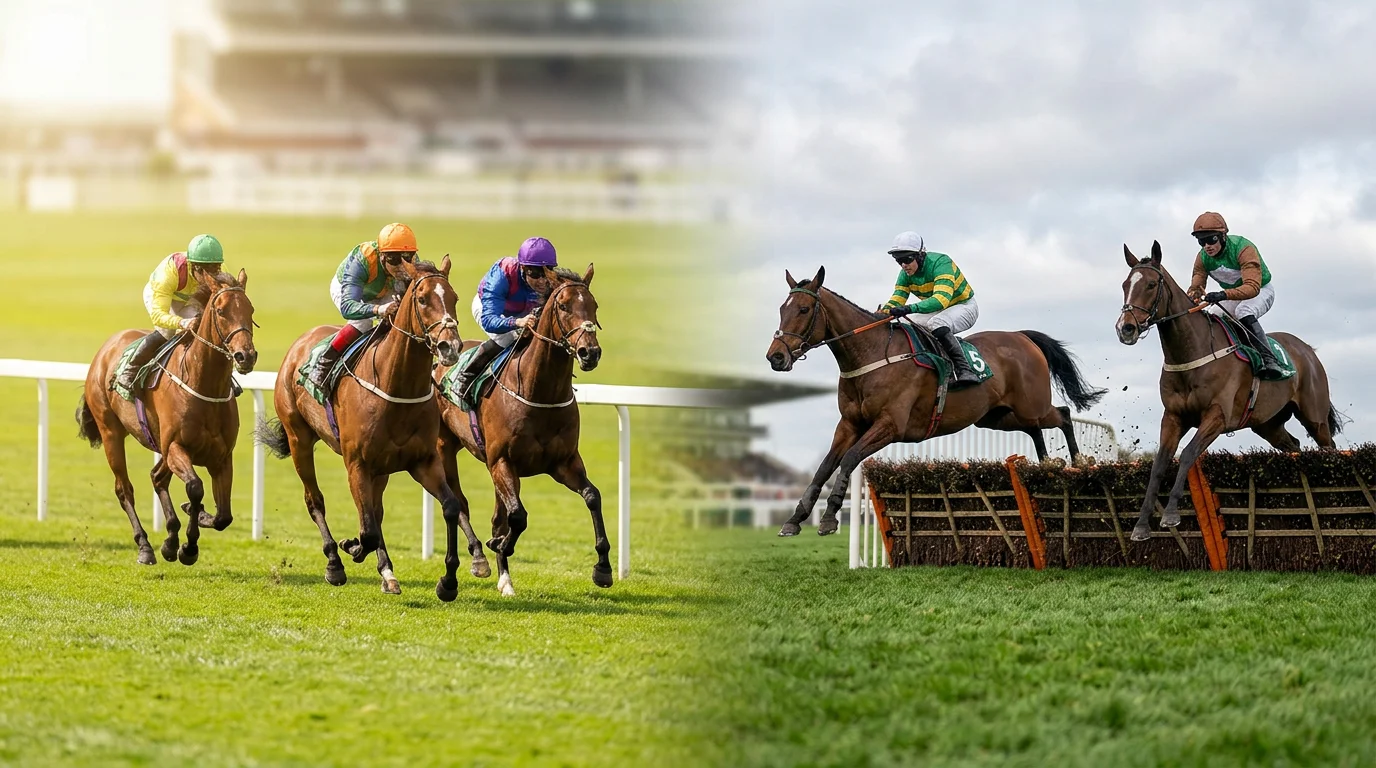
British horse racing is not a single sport. It is two codes, run under different rules, across different seasons, over different obstacles — or none at all. Flat racing and National Hunt racing share the same Thoroughbred bloodlines and often the same racecourses, but the resemblance fades fast once the stalls open or the tape rises. Understanding the split between these two codes is the first step toward making sense of any UK racing result, because the numbers on a result card mean different things depending on which code produced them. Flat vs National Hunt Racing — More on this topic at horseracing results.
Roughly 60% of the approximately 10,000 annual races in Britain are Flat contests, with the remaining 40% falling under National Hunt. That ratio matters. It shapes which results dominate the sports pages in summer, which dominate in winter, and why the terminology shifts when you move from one to the other. A Flat result card carries references to draw positions and furlong markers. A National Hunt card speaks of fences, hurdles and the weight of history carried by any horse still standing at the finish. Both are worth learning to read — and the differences are more than cosmetic.
This guide walks through the two codes of British racing in detail: how each discipline works, what separates them structurally, where they overlap on the calendar, and how their result formats diverge. Whether you follow the Flat from spring to autumn or spend your winters watching chasers slog through Cheltenham mud, the aim here is to sharpen the way you interpret results from either code.
Flat Racing: Surface, Distances and Class Structure
Flat racing is the older of the two codes, and in many ways the simpler to grasp. Horses run on level ground with no obstacles, competing purely on speed and stamina over distances that range from five furlongs (roughly 1,000 metres) to two miles and six furlongs. The bulk of Flat racing in Britain takes place on turf, though six racecourses — Wolverhampton, Kempton Park, Newcastle, Lingfield, Chelmsford City and Southwell — stage races on artificial all-weather surfaces year-round.
Distances shape everything on the Flat. Sprint races, run over five or six furlongs, are over in barely a minute and reward raw acceleration. Middle-distance contests — a mile to a mile and a quarter — demand a blend of tactical speed and endurance. Staying races beyond a mile and a half test stamina in a way that links back to the breed’s oldest traditions. The Classic races, the five contests that define the pinnacle of the Flat season, sit across this distance spectrum: the 1,000 and 2,000 Guineas at a mile, the Oaks and Derby at a mile and a half, and the St Leger at a mile and three-quarters. These are restricted to three-year-olds, and their results often determine which horses become the next generation of breeding stallions and broodmares.
The class structure on the Flat is layered and precise. At the top sit Group 1 races, followed by Group 2 and Group 3 — collectively known as Pattern races, regulated internationally to maintain consistent standards. Below them come Listed races, then a cascade of handicaps and conditions races graded by class from 1 down to 7. Handicaps, where horses carry different weights based on their Official Rating, account for the majority of Flat races and generate most of the betting turnover. A horse rated 95 carrying 9st 7lb faces a fundamentally different challenge from an unrated maiden attempting its first race, and a result card for a Class 2 handicap looks nothing like one from the Derby — even though both fall under the Flat umbrella.
One trend worth noting is the supply side. The foal crop born in 2025 stood at just 4,015, the lowest figure in two decades, down from 4,198 in 2024 and 4,510 in 2023. Fewer foals mean fewer horses entering training in future years, which will eventually thin out field sizes on the Flat. For anyone studying results, field size matters: the competitive dynamics of a five-runner Group 1 differ wildly from a twenty-runner nursery handicap. The shrinking foal crop is already shaping conversations about how British racing maintains its fixture list and the quality of racing across all tiers.
Surface also introduces a variable that many newcomers overlook. Turf form and all-weather form are not interchangeable. A horse that dominates on Lingfield’s Polytrack might flounder on Ascot’s straight course in soft ground, and vice versa. Results from all-weather meetings carry their own abbreviations and going descriptions — Standard, Standard to Slow, Fast — that differ entirely from the turf scale. When reading Flat results, it pays to check the surface first, because a string of impressive form figures on artificial ground may tell you very little about how that horse will handle Goodwood in July.
The Flat season on turf traditionally runs from April to November in Britain, though the precise start and end dates shift slightly each year. All-weather racing fills the gaps, running twelve months a year and providing opportunities for horses that might otherwise sit idle. In practical terms, this means Flat results never fully disappear from the calendar. There is always a card to study, always a result to dissect — but the character of those results changes markedly between a mid-summer Group 1 at York and a Tuesday evening handicap under Wolverhampton’s floodlights.
National Hunt: Hurdles, Chases and Bumpers
If Flat racing is about pure speed on a level playing field, National Hunt is about courage over obstacles and the stamina to keep jumping when fatigue sets in. The code encompasses three distinct race types: hurdle races, steeplechases and National Hunt Flat races (commonly called bumpers). Each type produces a different kind of result card, carries different risks and rewards, and attracts a different profile of horse.
Hurdle races are the entry point. Horses jump portable flights of hurdles — typically eight to twelve per race, depending on distance — that stand around 3 feet 6 inches tall and are designed to brush through rather than punish a horse that clips the top. Distances range from about two miles to three miles, though marathons beyond that distance exist. A hurdle race result will show finishing positions, distances between horses, starting prices and jockey silks, just like a Flat result, but it will also include non-completion codes that barely exist on the Flat. The letter F (fell), U (unseated rider) and P (pulled up) appear with far greater frequency in National Hunt results, because jumping is inherently riskier than galloping on the level.
Steeplechases raise the stakes. The fences are larger — a minimum of 4 feet 6 inches — and fixed rather than portable. Courses like Aintree, Cheltenham and Sandown feature varied fence types, including open ditches, water jumps and the notorious Chair fence at Aintree. Steeplechase distances start around two miles and extend beyond four miles in extreme tests like the Grand National. A retrospective study published in the Equine Veterinary Journal, examining data from 2010 to 2023, found that the fatality rate in steeplechases was 5.9 per 1,000 starts, compared with 4.5 per 1,000 starts in hurdle races. Those numbers underline a reality that shapes both the sport’s appeal and its scrutiny: chasing is demanding, and the results sometimes carry tragic footnotes.
Bumpers — National Hunt Flat races — are the odd one out. Despite falling under the National Hunt umbrella, they involve no jumping. Bumpers are run on the Flat, typically over two miles, and exist primarily to give young horses and former pointers their first experience of a racecourse environment. Results from bumpers lack the non-completion codes associated with jumping but still sit within the National Hunt results stream, filed under NH Flat rather than Flat proper. For a newcomer scanning a results page, this can be confusing: a race run without obstacles, listed among chases and hurdles. The distinction is administrative — bumper horses are typically bred and aimed at eventual jumping careers, even if they start on the level.
Weight is a constant theme in National Hunt racing, more so than on the Flat. Steeplechasers routinely carry between 10st and 12st, and handicap chases can see the top weight assigned 11st 12lb while a lightly raced novice gets in at 10st 0lb. The difference between those extremes is substantial over three miles and twenty fences. In result cards, you will see weight listed beside each runner’s name, and it is worth paying attention to: a horse that finishes third carrying twelve stone may have run a better race than one that won carrying ten, and a smart reader of results learns to adjust impressions accordingly.
The National Hunt season mirrors the Flat’s calendar in reverse. The core season runs from October to April, peaking with the Cheltenham Festival in March and the Grand National meeting at Aintree in April. Summer jumping does exist — a handful of fixtures continue through May, June and July — but the fields thin, the prize money drops and the quality is incomparable. The best jumps horses rarely appear between May and October. This seasonality means that National Hunt results cluster heavily in the winter months, and the result pages in January or February look very different from those in August, both in volume and in the calibre of horses involved.
One structural feature unique to National Hunt is the novice classification. A horse that has not won a hurdle race before the current season is classified as a novice hurdler; one that has not won a chase is a novice chaser. Novice races restrict the field to these less experienced runners, and their results are closely watched by professionals because they reveal the next wave of talent. A dominant novice hurdle winner in November often becomes a Cheltenham contender by March. Reading novice results with an eye to future potential is one of the more rewarding habits in National Hunt form study.
Head-to-Head: Flat vs National Hunt at a Glance
Laying the two codes side by side makes the contrasts sharper. The following comparison captures the structural differences that matter most when you are reading results, studying form or simply trying to understand what you are watching.
In terms of obstacles, Flat racing has none, while National Hunt features hurdles (3ft 6in) or fences (4ft 6in and above), though bumpers — NH flat races — have no obstacles either. Typical distances range from 5 furlongs to 2 miles 6 furlongs in Flat racing, compared with 2 miles to 4+ miles over jumps. Flat racing takes place on turf and all-weather surfaces (Polytrack, Tapeta, Fibresand), whereas National Hunt racing in Britain is turf only. The Flat turf season runs from April to November, with all-weather racing continuing year-round. The National Hunt core season spans October to April, with limited summer jumping. Flat horses can race from two years old. In National Hunt, the minimum age is four for hurdles and chases, and three for bumpers from winter onward. Weight allocations differ markedly: Flat runners typically carry 8st 0lb to 10st 0lb, while NH runners carry 10st 0lb to 12st 0lb. The Flat has five formal Classics — the Guineas, Oaks, Derby and St Leger. National Hunt has no formal Classics, but the Champion Hurdle, Gold Cup and Champion Chase serve as equivalents. Flat races are graded as Group 1, 2 and 3, plus Listed and Class 1–7 handicaps. National Hunt uses Grade 1, 2 and 3, plus Listed and Class 1–5 handicaps. Non-completions are rare in Flat racing (occasionally P for pulled up), but common over jumps: F (fell), U (unseated rider), P (pulled up), R (refused) and BD (brought down). The draw — stall position — can be highly significant on certain Flat courses and distances, but is minimal in National Hunt, where most starts are from a tape rather than stalls. The going scale on turf runs from Hard through Firm, Good to Firm, Good, Good to Soft, Soft and Heavy for both codes. All-weather surfaces use a separate scale: Standard, Standard to Slow and Slow.
A few entries deserve extra commentary. The grading difference — Group versus Grade — is more than a naming convention. Flat Pattern races are internationally harmonised under the European and International Pattern Committee, which means a Group 1 at Ascot carries equivalent status to a Group 1 at Longchamp or the Breeders’ Cup. National Hunt Grade 1 races are governed by a separate committee, and while they hold equivalent prestige within the jumping world, they operate on a different international framework. When you see “G1” on a result card, the code tells you which framework applies.
The draw column deserves particular emphasis. On the Flat, stall position can be decisive — Chester, Beverley and the straight courses at Ascot and Newmarket all exhibit measurable draw biases depending on the going and the field size. National Hunt racing sidesteps this variable entirely by starting from a tape rather than stalls. That single difference changes the analytical approach to reading results: on the Flat, the draw is data you must account for; in jumping, it simply does not exist.
When Each Code Runs: The British Racing Calendar
The British racing calendar is not a single timeline but two overlapping ones, stitched together by a handful of months where both codes compete for attention. Understanding when each code runs — and when it peaks — is essential for anyone trying to follow results systematically.
The Flat turf season typically opens in late March or early April, with the Doncaster meeting serving as the traditional curtain-raiser. From there, the calendar builds through spring and into the summer, hitting its highest points at Royal Ascot in June, the July meeting at Newmarket, Glorious Goodwood in late July and August, and the St Leger Festival at Doncaster in September. The season tapers off through October and closes in November, usually at Doncaster again. All-weather Flat racing operates continuously throughout this period and beyond, filling every month of the calendar with cards at Kempton, Lingfield, Wolverhampton, Newcastle, Chelmsford and Southwell.
National Hunt picks up as the Flat winds down. The jump season launches in earnest in October, though some early-season fixtures appear in September. The autumn months are packed with novice hurdles and early-season chases as trainers assess their strings. November brings the first major Graded contests — the Betfair Chase at Haydock, the BetVictor Gold Cup at Cheltenham and a series of trials that begin to reveal the pecking order for the spring festivals. December is dominated by Christmas meetings at Kempton (featuring the King George VI Chase on Boxing Day), Leopardstown (the Irish equivalent) and Chepstow (the Welsh Grand National). January and February are trial season, with Cheltenham’s own January and Festival Trials days plus a string of competitive handicaps at places like Musselburgh, Warwick and Doncaster.
March and April are the crescendo. The Cheltenham Festival across four days in mid-March is the pinnacle of National Hunt racing, and the Grand National meeting at Aintree follows roughly three weeks later. After Aintree, the jump season cools rapidly. Sandown’s season-finale meeting in late April is considered the formal finale, though a handful of summer jumping fixtures continue into May and beyond.
The 2026 fixture list published by the British Horseracing Authority schedules 1,458 fixtures across both codes, a slight reduction from 1,460 in 2025 and 1,468 in 2024. That trim reflects a deliberate strategy. As Richard Wayman, the BHA’s Director of Racing, explained, the list was developed to deliver “high quality, competitive and engaging racing, which is attractive to those who own, train and run horses in Britain.” The emphasis is on concentrating quality rather than spreading it thin — fewer fixtures, but with stronger fields and better competition at each one.
For the result-watcher, the calendar overlap between codes creates a practical consideration: during October, November and March, both Flat and National Hunt fixtures run simultaneously, sometimes at the same racecourse on different days. A results page on a busy Saturday in October might show a Group 1 Flat race from Ascot alongside a Grade 2 hurdle from Chepstow. Knowing which code you are looking at before diving into form figures and finishing orders saves confusion and prevents misinterpreting a piece of data designed for one code as if it belonged to the other.
How Results Pages Look Different for Each Code
Pull up a race result from a Flat handicap at Newbury and compare it with a handicap chase result from the same course, and the structural differences become obvious within seconds. Both cards share a core template — finishing positions, horse names, jockeys, trainers, starting prices and official ratings — but the additional data surrounding that core shifts meaningfully between codes.
On a Flat result card, the draw column sits prominently near the top. Each horse is assigned a stall number, and that number appears in brackets next to the horse’s name. For courses where the draw is statistically significant — Chester, Beverley, Musselburgh on certain ground — this column is one of the first things a serious analyst checks. It tells you whether a horse had a built-in advantage or disadvantage before the race even started. National Hunt result cards drop this column entirely. There are no starting stalls in jumping (with rare exceptions in bumpers at some courses), so the concept of a draw advantage does not apply.
Going descriptions on the result card are another divergence. Both codes use the standard turf scale from Hard through to Heavy, but Flat racing adds a parallel scale for all-weather surfaces. A result from Kempton on a Wednesday evening might read “Standard” or “Standard to Slow,” which has no equivalent in the National Hunt lexicon. The going matters enormously to form study in both codes, but an all-weather going description tells you something qualitatively different from a turf one: artificial surfaces drain more consistently and produce narrower variation in conditions, which means form on all-weather tends to be more reliable and predictable than form on winter turf.
Non-completion data is where the codes diverge most sharply. In Flat racing, nearly every runner finishes the race. The occasional P (pulled up) appears when a horse is clearly struggling, and very rarely a horse may be brought down in a multi-runner sprint, but these incidents are statistical outliers. In National Hunt racing, non-completions are a routine feature. A twelve-runner steeplechase in which three or four horses fail to finish is unremarkable. The result card for such a race will list the finishers in order and then show the non-completers beneath, each tagged with a code: F for fell, U for unseated rider, P for pulled up, R for refused, BD for brought down, CO for carried out, and SU for slipped up. Reading NH results without understanding these codes means missing a significant chunk of the narrative — a horse that unseated its rider at the last while leading is not the same as one that was pulled up after three fences because it was never travelling.
Race timing and sectional data also present differently. The BHA’s quarterly reports note that 82.2% of races in 2025 started within two minutes of their scheduled time, an improvement on previous years. That punctuality figure applies across both codes, but the nature of timing data within results differs. Flat racing increasingly offers sectional times — splits for each furlong or half-mile segment — which allow analysts to see where a race was won or lost. Sectional timing on National Hunt courses is rarer, partly because the distances are longer and the variables (jumping errors, pecking on landing) make splits less clean. Some National Hunt tracks do offer sectionals via TurfTrax equipment, but the data is not yet universal. A Flat result card from Ascot in 2026 might include furlong-by-furlong splits; a chase result from Uttoxeter almost certainly will not.
Finishing distances — the gaps between horses at the line — are described using the same scale in both codes (short head, head, neck, half a length, lengths, and so on up to “distance” for a gap of more than thirty lengths). However, the typical margins differ. Flat races, particularly sprints, are decided by fractions: a nose, a short head, a neck. National Hunt races, especially long-distance chases, often produce wider margins. A winning distance of eight lengths in a three-mile chase is unremarkable; the same margin in a six-furlong Flat sprint would be extraordinary. When reading results, calibrate your expectations by the code. A three-length winning margin in a Grade 1 hurdle is comfortable but not dominant. The same margin in the 2,000 Guineas would be a rout. See also How to Read Horse Racing Results.
Finally, the weight column carries different implications across the two codes. Flat handicap weights tend to cluster in a narrower range — perhaps 8st 7lb to 10st 0lb — and the weight difference between top and bottom is often around a stone and a half. National Hunt handicap weights are heavier and the spread can be wider, sometimes exceeding two stone from top to bottom. Because National Hunt horses carry more weight over longer distances and over obstacles, the impact of each additional pound is arguably greater. A horse conceding a stone to its rivals over two miles and a dozen hurdles is doing more work than one conceding the same amount over six furlongs on the Flat. Both result cards list the weight, but the analytical weight — the significance of that number — differs by code.
