
 Available in US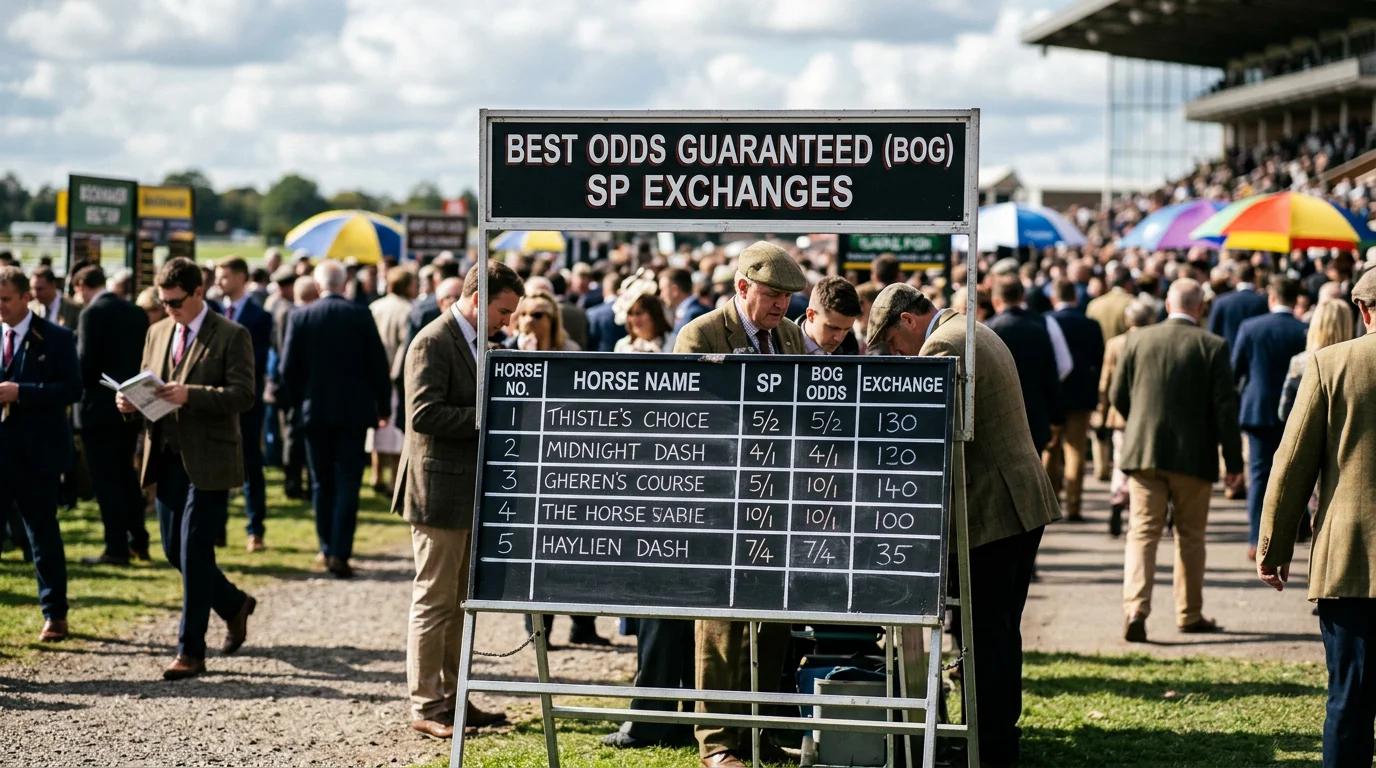
Every horse racing result is surrounded by markets — fixed-odds prices set by bookmakers, exchange odds determined by punters trading against each other, and Starting Prices compiled from the on-course ring. These are not merely different ways to place a bet; they are different pricing mechanisms that produce different odds, different payouts, and different implications for how you read a result. The markets that surround every result form an ecosystem that is as revealing as the finishing order itself. Betting Markets and Horse Racing Results — More on this topic at horseracing results.
The overall betting market on British racing has been shifting. Aggregate wagering turnover fell by 4.2% in the first nine months of 2025 compared to the previous year, and by 12.8% against 2023. Understanding where that money is going — and which market mechanism offers the best value for the punter — requires a closer look at how each system works and how they interact with the official result.
Fixed-Odds Bookmakers vs Betting Exchanges
The fixed-odds market is what most British punters use. You open an account with a licensed operator — one of the dozens available in the UK — and you take a price on a horse. That price is locked in at the moment you bet. If the horse wins, you collect at the agreed odds regardless of how the market moved after your bet was placed.
The bookmaker sets those odds by assessing each horse’s chance and building in a margin — the overround — that ensures a theoretical profit across the entire book. A perfectly fair market on a ten-horse race would price the field so that the implied probabilities sum to 100%. In practice, bookmakers price the field to sum to 115% or more, with the excess representing their margin. This overround is the price you pay for the convenience and certainty of fixed odds.
Betting exchanges operate on a fundamentally different model. On a betting exchange, there is no traditional operator setting the odds. Punters bet against each other: one person backs a horse (betting it will win) and another lays it (betting it will not). The exchange takes a commission on winning bets — typically 2% to 5% — rather than building a margin into the odds. The result is that exchange odds are generally more accurate reflections of true probability, and they are often larger than the equivalent bookmaker price because the exchange has no overround to cover.
The off-course betting market as a whole was valued at £3.33 billion in turnover as of March 2023, though that figure has declined by 42% from its 2009 peak. The shift from shops to online accounts, the growth of exchanges, and the emergence of in-play betting have all reshaped how money flows around each race — and those flows are visible in the price movements that precede every result.
For results analysis, the distinction matters because SP — the official settling price — is derived from the on-course fixed-odds market, not the exchange. A horse may drift to 20/1 on the exchange while remaining 14/1 with on-course bookmakers, and the SP will reflect the latter. Knowing which market you are reading helps you interpret what the price movements mean and how the result compares to expectations.
Best Odds Guaranteed: How It Works and Who Offers It
Best Odds Guaranteed, or BOG, is a promotional tool that blurs the line between fixed odds and SP. Under BOG, if you take a fixed price and the SP returns higher, the bookmaker pays you at the better price. If the SP is lower, you keep your original odds. It is, in effect, a free option on the SP — and it has become a standard offering from most major online bookmakers.
The mechanics are simple. You back a horse at 8/1 on Tuesday morning. By race time on Saturday, the on-course market has let the horse drift to 12/1, and that becomes the SP. Under BOG, your bet is settled at 12/1 rather than 8/1 — an automatic upgrade that requires no action on your part. If the horse had been backed down to 5/1 SP, your bet would remain at 8/1. Either way, you get the better of the two prices.
BOG is not universally available. It typically applies to UK and Irish horse racing only, and most bookmakers exclude certain races (ante-post markets, international racing, enhanced-odds promotions). Some operators cap the maximum payout uplift from BOG. The terms vary, and checking them before relying on BOG as part of your strategy is worthwhile.
Anne Lambert, Interim Chair of the Horserace Betting Levy Board, has confirmed that betting turnover per race declined by 8% year on year, with steeper drops against earlier years. In a market where turnover is falling, BOG represents one of the few areas where the punter has gained ground — a genuine value proposition that the bookmakers fund as a customer-acquisition tool but that savvy punters can exploit systematically by always taking the best available fixed price on BOG-eligible races.
Rule 4 Deductions: When a Runner Withdraws
Rule 4 is the mechanism that adjusts your payout when a horse is withdrawn from a race after you have already placed your bet. It exists because the withdrawal of a runner changes the competitive balance of the race: if the favourite is withdrawn, every remaining horse has a better chance of winning, and the odds at which you took your bet no longer accurately reflect the true probability.
The deduction is expressed as a number of pence in the pound, and it scales with the price of the withdrawn horse. If the withdrawn horse was 1/1 (even money), the Rule 4 deduction is 45p in the pound — nearly half your potential winnings are clawed back. If the withdrawn horse was 14/1, the deduction is 5p in the pound — a minor adjustment. The shorter the price of the withdrawn horse, the larger the deduction, because its removal has a greater impact on the chances of the remaining runners.
Rule 4 applies to all fixed-odds bets placed before the withdrawal, including ante-post bets. It does not apply to bets placed after the withdrawal (since those bets were priced on the reduced field) or to exchange bets (which have their own market mechanisms for handling withdrawals). Tote pool bets handle non-runners differently again, typically returning the stake on the withdrawn horse.
For results analysis, Rule 4 is relevant because it appears in the official result record alongside the SP. A result might note “Rule 4: 20p in the pound” — meaning a runner was withdrawn late enough to trigger the deduction, and all bets on the remaining horses are subject to it. When comparing SPs and payouts across historical results, failing to account for Rule 4 deductions will distort your calculations and lead to inaccurate profit-and-loss assessments. See also UK Horse Racing Economics.
The markets that surround every result are not mere background noise. They are data — data about what the collective intelligence of thousands of punters believed would happen, data about how money moved in the hours and minutes before the off, and data about the mechanisms through which the sport’s economics are expressed. Reading the result without reading the market is seeing only half the picture.
