
 Available in US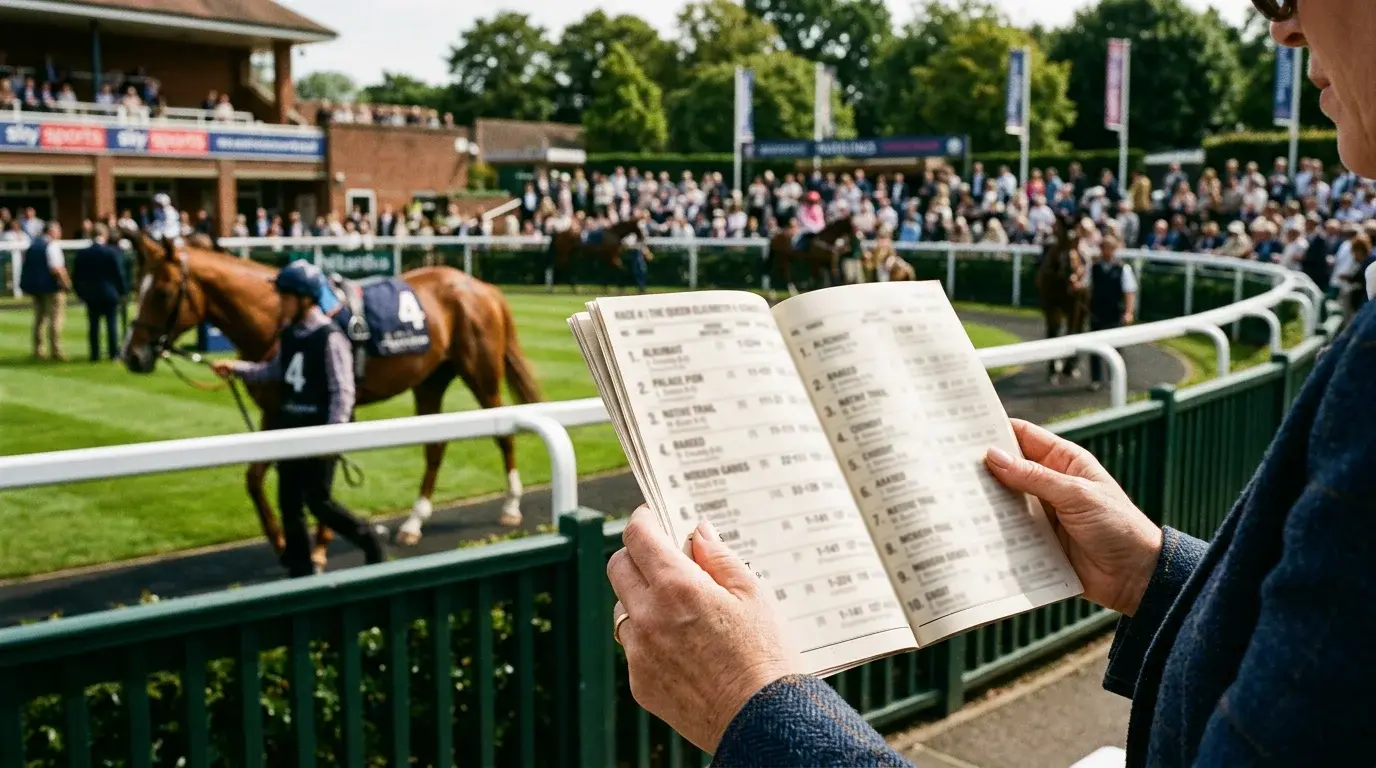
Before a single horse enters the stalls, the racecard has already told you everything you need to know — if you can read it. The racecard is the pre-race document that lists every runner, its connections, its form, its weight, its draw, and a battery of coded information that, decoded, gives you everything you need before the race begins. Racecards Explained — More on this topic at horseracing results.
For newcomers, a racecard looks like a spreadsheet designed by someone who resented clarity. Numbers, letters, abbreviations, and symbols crowd every line, and nothing is explained. For experienced racegoers, it is the most information-dense document in sport — a single page that compresses days of form study into a scannable format. This guide walks through every field on a standard UK racecard, explains the headgear symbols that signal trainer intent, and shows how the racecard connects to the post-race result.
Field-by-Field: Anatomy of a Racecard
A standard UK racecard — whether printed at the racecourse, displayed on Racing Post, or shown on Sporting Life — contains a consistent set of fields for each runner. The layout varies between platforms, but the data is the same.
Draw number appears first in Flat races. This is the stall position from which the horse will start, and on certain courses it carries significant weight. At Chester, a low draw is a major advantage in sprint races; at Beverley, high draws are favoured over five furlongs. Across Britain’s 59 racecourses, the draw’s impact varies so much that checking the course-specific bias before the race is one of the simplest edges available. In National Hunt racing, there are no starting stalls and therefore no draw number.
Cloth number is the number the horse carries on its saddlecloth — the visual identifier used by commentators and the judge. It does not correspond to the draw in Flat races (the draw is assigned separately), so a horse with cloth number 1 might be drawn in stall 12.
Horse name, age, and sex form the core identification. A racecard might show “Cityscape (5, g)” — meaning a five-year-old gelding. Mares are marked “f” (filly, aged four or younger) or “m” (mare, aged five or older). Colts are “c” and horses (entire males aged five-plus) are “h”. Age matters because weight-for-age allowances apply in many races, giving younger horses a weight reduction against older opponents.
Weight is expressed in stones and pounds — for example, “9-7” means 9 stone 7 pounds. In handicaps, the weight is determined by the horse’s Official Rating; in non-handicaps, it follows the race conditions (weight-for-age scales, sex allowances, or penalties for recent winners). The weight column is the direct output of the handicapping system: a higher weight means a higher-rated horse, and the relationship between weight and rating is the starting point for any handicap analysis.
Trainer and jockey are listed for each runner, sometimes with the jockey’s claiming allowance shown in brackets. A racecard showing “J. Smith (5)” indicates an apprentice or conditional jockey claiming a five-pound weight allowance. The trainer-jockey combination is a data point in itself: certain partnerships produce strike rates above either individual’s average, and identifying them on the racecard is a quick analytical shortcut.
Form figures — the string of numbers and letters summarising recent finishing positions — appear alongside the horse’s name. These are the compressed history of the horse’s recent races, with the most recent run on the right. A form string of “21-41” tells you the horse finished second, then first in a previous season, and has started the current season with a fourth and a first. Reading form figures fluently is the single most important skill for any racecard user.
Official Rating (OR) appears on detailed racecards, showing the BHA handicapper’s assessment of the horse’s ability. Comparing the OR across the field tells you which horses are theoretically the best — and which might be well handicapped if other rating systems (RPR, Timeform) assess them higher.
Colours — the silks worn by the jockey — are described on the racecard in a standardised shorthand: “Red, white star, blue sleeves” tells you exactly what to look for through binoculars. For television viewers and those following the race live, the colours are the primary means of identifying horses. The silks are registered to the owner, not the horse, so a horse that changes ownership may race in different colours from one run to the next.
Days since last run is shown on some digital racecards and provides an at-a-glance indication of how recently the horse was in action. A horse returning after 200 days is coming back from a long absence; one running after 14 days is being campaigned frequently. Both patterns carry analytical implications that are worth checking before the race.
Headgear Symbols: What Blinkers, Cheekpieces and Visors Mean
Headgear codes appear in brackets or as superscript letters next to the horse’s name on the racecard. They indicate equipment changes that the trainer has chosen for this particular run, and they are among the most actionable pieces of information on the card.
b — Blinkers. Cups that restrict peripheral vision, forcing the horse to focus forward. First-time blinkers are one of the strongest positive signals on a racecard: they suggest the trainer believes the horse has untapped ability and needs help concentrating.
v — Visor. A less restrictive alternative to blinkers with a narrow slit for partial peripheral vision. Often tried when full blinkers are considered too strong a measure.
t — Tongue tie. A strap that holds the tongue in place, preventing it from obstructing the airway. First-time tongue tie is another strong positive signal — it addresses a physical issue that may have been limiting the horse’s breathing and therefore its performance.
h — Hood. Covers the horse’s ears to reduce noise sensitivity, usually removed at the start. Primarily a calming aid rather than a performance enhancer.
p — Cheekpieces. Sheepskin strips on the cheekpieces of the bridle, a milder version of blinkers. Sometimes used as a stepping stone before applying full blinkers.
The key notation to watch for is “1” appended to any headgear code — for example, “b1” or “t1” — which indicates first-time application. With 21,728 horses in training across Britain, a significant number will try new headgear in any given week, and the statistics consistently show that first-time application produces a measurable uplift in performance compared to the horse’s previous runs.
Connecting the Racecard to the Post-Race Result
The racecard and the result are two halves of the same document. The racecard tells you what was expected; the result tells you what happened. Reading them together — rather than treating each in isolation — is where the real analytical value lies.
After a race, go back to the racecard and check the fields against the result. Did the horse drawn in stall one, which had a theoretical draw advantage, use that advantage? Did the first-time blinkers produce the expected improvement? Was the horse carrying the lowest weight in the handicap competitive despite its lower rating? See also Betting Markets and Horse Racing Results.
This post-race review turns the racecard from a disposable pre-race document into a permanent analytical tool. Over time, the habit of connecting racecards to results builds pattern recognition — you start to notice which racecard indicators reliably predict performance and which are noise. That pattern recognition, accumulated across hundreds of races, is the foundation of informed form analysis and everything you need before the race begins becomes everything you use after it ends.
