
 Available in US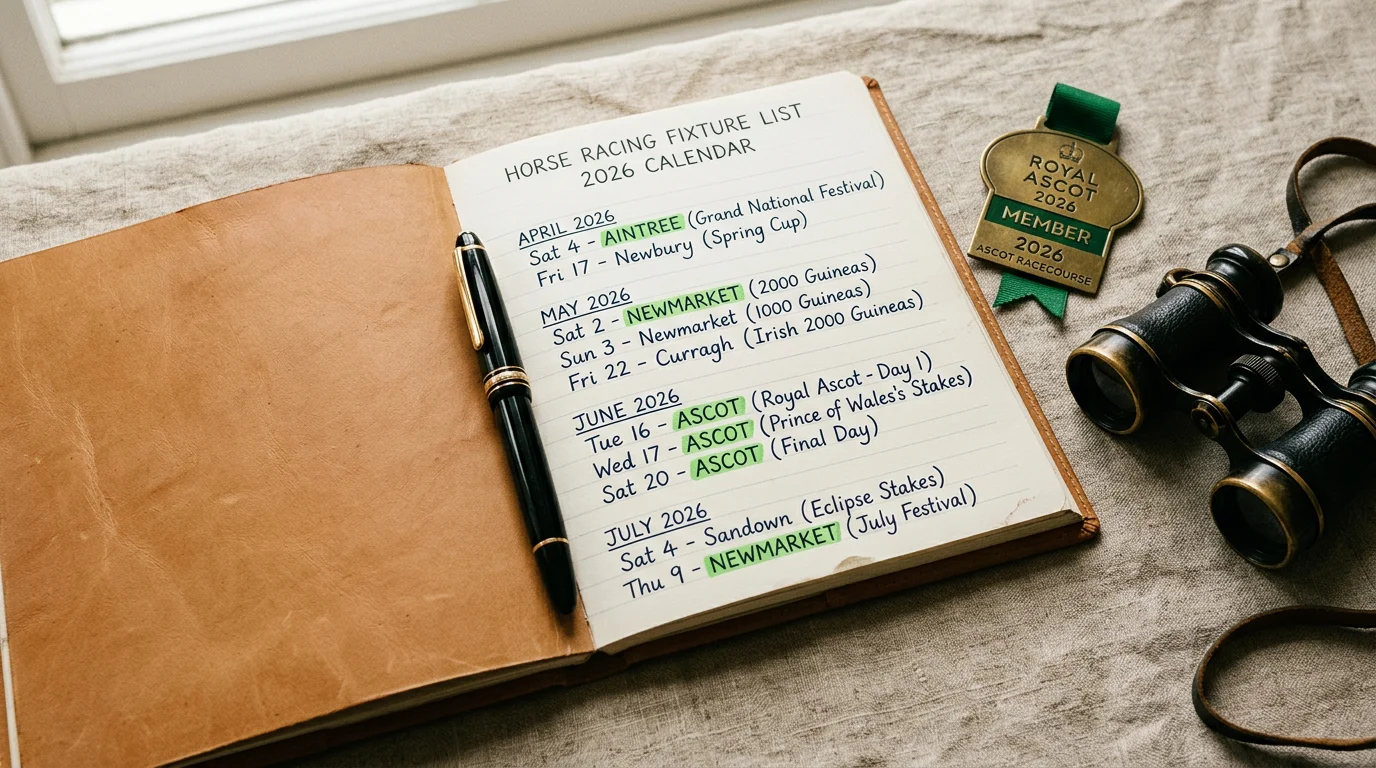
The 2026 British racing calendar comprises 1,458 fixtures — a slight reduction from 1,460 in 2025 and 1,468 in 2024. The direction of travel is clear: fewer meetings, but with an emphasis on stronger fields and better-quality racing at those that remain. Every date, every venue, every change for 2026 is driven by a strategic rethink that has reshaped the calendar more fundamentally than the modest headline numbers suggest. Horse Racing Fixture List 2026 — More on this topic at horseracing results.
For punters and racegoers, the fixture list is the scaffolding around which the entire season is built. It determines when the major festivals fall, which courses host the midweek cards, and how the all-weather programme dovetails with the turf season. Understanding the 2026 list — particularly the significant structural changes to the Premier Raceday category — is essential for planning which meetings to attend, which results to follow, and where the strongest form is likely to be produced. This guide breaks down the headline changes, walks through the calendar month by month, and explains how the BHA constructs and adjusts the fixture list each year.
2026 Headline Changes: From 162 to 52 Premier Racedays
The most striking change in the 2026 fixture list is the dramatic reduction in Premier Racedays — the BHA’s top-tier classification for the most prestigious meetings. In previous years, the Premier category encompassed 162 racedays. For 2026, that number has been cut to 52 — 30 on the Flat and 22 over jumps.
This is not a contraction of the sport. It is a recalibration. The BHA’s logic is that spreading the Premier label across 162 days diluted its meaning and the quality of the product. By concentrating the designation on 52 genuinely premium fixtures, the aim is to ensure that each Premier Raceday delivers larger fields, better horses, higher prize money, and a stronger spectacle. Richard Wayman, the BHA’s Director of Racing, stated that the 2026 list was designed to deliver high quality, competitive and engaging racing that appeals to owners, trainers, and those who run horses in Britain.
The practical consequence is that the gap between a Premier Raceday and a standard fixture has widened. Premier meetings will benefit from enhanced prize money, priority scheduling (avoiding clashes with other major sporting events), and greater media focus. The remaining fixtures — Core and standard racedays — continue to fill the calendar but without the promotional support and financial incentives that the Premier tag carries.
For punters, this means that results from Premier Racedays in 2026 carry more form weight than in previous years. The fields will be stronger, the competitive level higher, and the results more reliable as indicators of true ability. Conversely, results from standard midweek fixtures — while still valuable — will often feature weaker fields and less reliable form. Adjusting your analysis to account for the quality tier of the meeting is a simple but effective refinement.
Month-by-Month Overview: When and Where to Watch
The 2026 calendar follows the established seasonal rhythm of British racing, with all-weather fixtures dominating the winter and turf racing building from spring through to autumn’s finale.
January to March is the heart of the National Hunt season and the all-weather Flat programme. The major jump meetings — the Christmas festivals at Kempton and Leopardstown, the New Year fixtures at Cheltenham and Sandown, and the build-up to the Cheltenham Festival in March — provide the headline results. All-weather racing at Kempton, Lingfield, Wolverhampton, Newcastle, and Southwell fills the midweek slots and offers competitive Flat racing throughout.
April to June sees the transition to the turf Flat season. The Guineas meeting at Newmarket in early May opens the Classic campaign, followed by the Derby at Epsom in June and Royal Ascot later that month. The Grand National at Aintree in April provides the National Hunt season’s final blockbuster before jump racing pauses for the summer. Racecourse attendance across the first nine months of 2025 rose by 4.9% year on year, and the spring and early summer months are typically the strongest period for on-course crowds.
July to September is peak Flat season. Glorious Goodwood, the Ebor Festival at York, and the St Leger at Doncaster are the flagship meetings. Evening racing at courses like Ascot, Newbury, and Windsor adds a social dimension. This is the period when the Flat form book is at its most reliable, with consistent summer ground and regular fixtures producing clear form lines.
October to December brings the return of jump racing alongside the Flat’s autumn climax. Champions Day at Ascot in October closes the top-level Flat season. The winter jumps programme builds through November and December, with the Betfair Chase at Haydock, the King George at Kempton on Boxing Day, and the Welsh Grand National at Chepstow providing the major results. All-weather racing resumes its dominant role in the Flat calendar as the turf courses close for the winter. The Christmas and New Year period is one of the busiest stretches of the entire calendar, with multiple fixtures on Boxing Day, New Year’s Day, and the days in between — a tradition that makes racing one of the few sports to compete directly with the Premier League for the festive audience.
How the BHA Sets and Adjusts the Fixture List
The fixture list is not drawn up on a whim. It is the product of months of consultation between the BHA, the racecourses, trainers’ and jockeys’ representatives, owners’ associations, and the betting industry. The process balances competing interests: racecourses want as many fixtures as possible to generate revenue, while trainers and the BHA want fields spread across fewer, better-quality meetings.
The BHA publishes the fixture list in late summer for the following year, with the broad framework set well in advance to allow racecourses to plan hospitality, sponsorship, and staffing. Within that framework, individual fixtures can be adjusted — moved to different dates, switched between courses, or abandoned due to weather. The process for handling abandonments is well-established: if a course fails an inspection due to frost, waterlogging, or unsafe ground, the meeting is either rescheduled to the next available date or the races are redistributed to other venues.
The current fixture-setting process reflects lessons learned from years when the calendar was arguably too large. More fixtures did not always mean more runners; in some cases, they meant smaller fields, lower-quality racing, and reduced betting turnover per meeting. The 2026 list represents the BHA’s attempt to find the right balance — enough fixtures to sustain the industry’s workforce and revenue needs, but not so many that quality is sacrificed. The results produced across the season will, ultimately, be the measure of whether that balance has been struck correctly. See also Prize Money in British Horse Racing.
For the racegoer planning their year, the fixture list is the starting document. Identifying the Premier Racedays, cross-referencing them with the major festivals, and building a personal calendar around the meetings that matter most is the first step towards engaging with the season. And for the form analyst, knowing when and where the strongest fields will assemble — and which fixtures are likely to produce the most reliable results — is the foundation upon which every assessment is built. The 2026 fixture list, with its reshuffled Premier tier and its carefully managed total, is the canvas on which the season’s story will be painted.
