 Available in US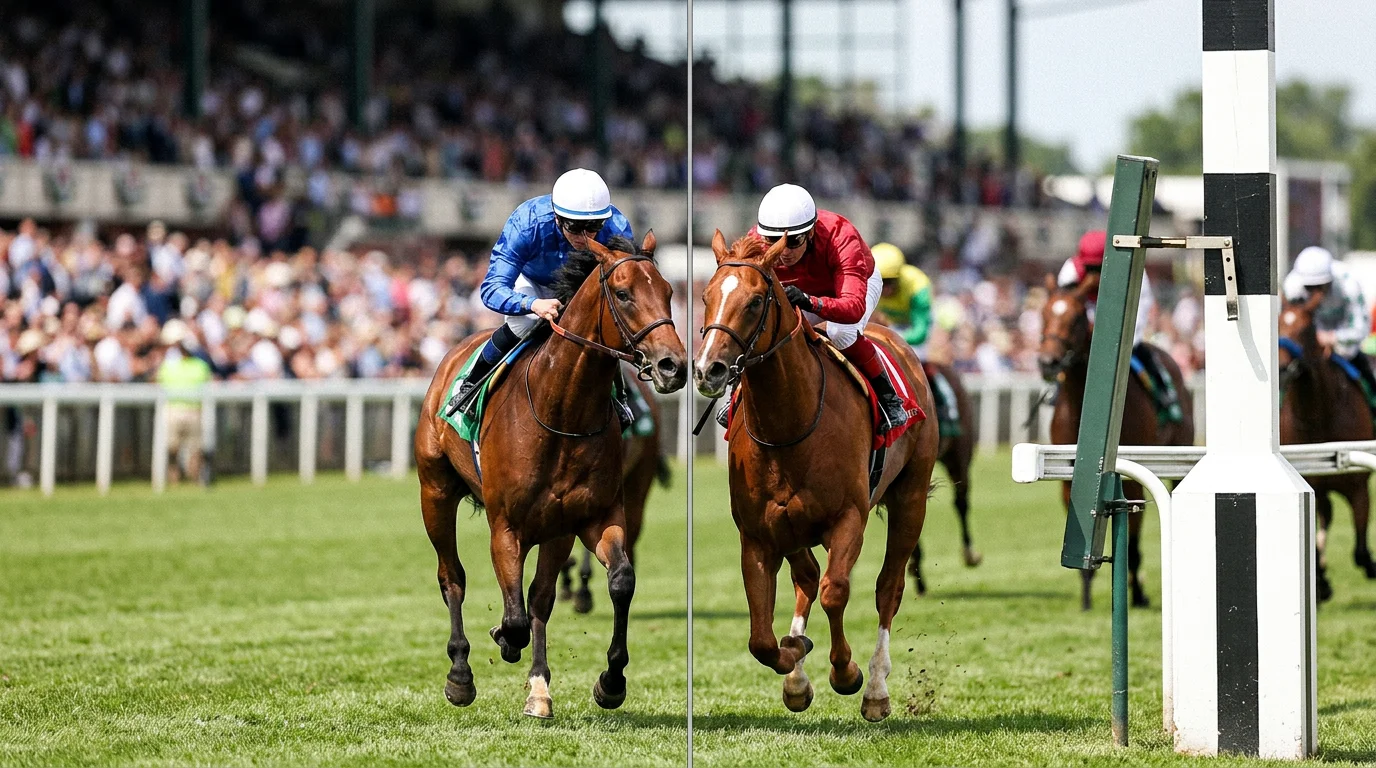
Horse racing is a sport decided by margins — a nose, a short head, sometimes a pixel on a photo-finish image. But occasionally, no margin exists at all. When the camera cannot split them, the result is a dead heat: two or more horses officially sharing the same finishing position. It is one of the rarest outcomes in British racing, and one of the most misunderstood. Dead Heat Rules in UK Horse Racing Results — More on this topic at horseracing results.
Dead heats trigger a cascade of consequences that go far beyond a shared trophy. Prize money is divided, betting payouts are halved, and the official result carries a notation that most punters encounter so infrequently they have no idea how to read it. For a sport that prides itself on precision — where finishing distances are measured in fractions of a length and technology can determine separations invisible to the human eye — the admission that two horses simply cannot be separated is an unusual concession.
This guide explains the formal BHA regulations governing dead heats, walks through how payouts are calculated under both SP and Tote rules, and revisits some of the most memorable dead heats in British racing history.
The Official Dead Heat Rule: BHA Regulations
Under BHA Rules of Racing, a dead heat is declared when the judge — using the photo-finish camera — determines that two or more horses crossed the line simultaneously and cannot be separated. The technology involved is highly sophisticated: modern photo-finish cameras capture a continuous image along the finish line at a resolution that can detect separations of less than a centimetre. For a dead heat to be declared, the noses of the horses involved must be exactly level in the captured image.
The formal process begins at the moment the judge reviews the photo. If the judge can see any separation — however tiny — a winner will be declared. Only when the image shows the horses genuinely inseparable does the judge call a dead heat. This decision is final: there is no appeal, no re-examination, no video-review override. The photo-finish image is the definitive record.
When a dead heat for first place is declared, both horses are recorded as joint winners. The result card will show them sharing the same position — typically annotated with “DH” or “dead heat” alongside the finishing position. For prize money purposes, the first and second prize are combined and split equally between the two winners. If the first prize is £20,000 and the second prize is £10,000, each dead-heating horse receives £15,000. Third prize remains with the horse that finished third.
Dead heats can also occur for places other than first. A dead heat for second, for instance, means two horses share the runner-up position, with the second and third prizes combined and split. The same principle cascades down the finishing order as needed.
Across the 1,458 fixtures planned for 2026, dead heats will occur perhaps a handful of times. They are statistically rare — the precision of photo-finish technology means that the vast majority of apparently close finishes can, in fact, be separated. When they do occur, they generate disproportionate attention precisely because of their novelty.
How Dead Heat Payouts Are Calculated for SP and Tote
For punters, the dead heat rule has one immediate and often unwelcome consequence: your payout is reduced. The mechanism is straightforward but catches many bettors off guard the first time they encounter it.
Under standard dead heat rules for fixed-odds and SP bets, your stake is divided by the number of dead-heating horses, and your payout is calculated on that reduced stake at the full odds. If you backed a horse at 10/1 with a £10 stake and it dead-heats with one other horse, your bet is settled as: half your stake (£5) at 10/1 = £50 return, plus your £5 reduced stake returned = £55 total. You lose the other £5 of your original stake. Compare that to a clean win, where the same bet would return £110. The dead heat has cost you exactly half your potential profit.
For each-way bets, the dead heat rule applies separately to each part. If your horse dead-heats for the win, the win portion of your stake is halved and settled at full odds; the place portion pays as normal (since a dead-heat winner qualifies for a place). If your horse dead-heats for a placing position rather than first, only the place portion is affected — it is halved and settled at the place terms.
Tote pool bets handle dead heats slightly differently. In the Tote Win pool, the total pool is divided between all winning units — so if two horses dead-heat, the pool is shared between backers of both horses. The Tote dividend published in the result will reflect this division, often producing a smaller payout than the SP equivalent for the more heavily backed of the two dead-heaters, and a larger payout for the less fancied one. In the wider context of a market where remote horserace betting alone yielded £766.7 million in GGY during the 2024-25 period, dead heat deductions represent a tiny fraction of total payouts — but for the individual punter whose winner has been halved, the impact is sharp.
For accumulator bets, the dead heat settlement flows through to the next leg. Your reduced return from the dead-heat leg becomes the running stake for the next selection. This means a dead heat in the first leg of a four-fold does not void the bet — it simply reduces the rolling stake, and therefore the final payout, by the appropriate fraction.
Notable Dead Heats in British Racing History
Dead heats at the highest level of British racing are exceedingly rare, which makes the occasions they do occur all the more memorable.
One of the most significant in modern memory was the 2011 dead heat at Doncaster between Ektihaam and Fathom Five in the November Handicap, one of the oldest and most prestigious handicap races on the Flat calendar. The photo-finish image showed two noses absolutely inseparable, and the crowd’s anticipation during the judge’s deliberation was palpable — minutes of silence before the announcement that the camera could not split them.
Further back, the 1989 Champion Stakes at Newmarket produced a dead heat between Legal Case and the French raider Indian Skimmer, two high-class performers whose shared result generated debate for weeks over whether the technology had failed to identify a gap visible to spectators at the track. It had not — the camera was correct, and the finish remains one of the tightest in Group 1 history.
Dead heats occasionally occur in handicap hurdles and steeplechases too, where the margin of a dead heat feels even more improbable given the larger distances involved and the physical chaos of jumping. A dead heat over fences, after three miles of obstacles, feels like a scripted ending — and yet the photo-finish camera does not lie. See also How to Read Horse Racing Form Figures Step by Step.
What unites all these occasions is the reaction they produce. In a sport that rewards certainty — punters want winners, not draws — a dead heat is an interruption of the expected narrative. But it is also a reminder that horse racing, for all its data and technology, remains a sport where two living athletes can be so perfectly matched that even a camera running at thousands of frames per second cannot tell them apart. When the camera cannot split them, the result stands as an honest admission: these horses were equal.
